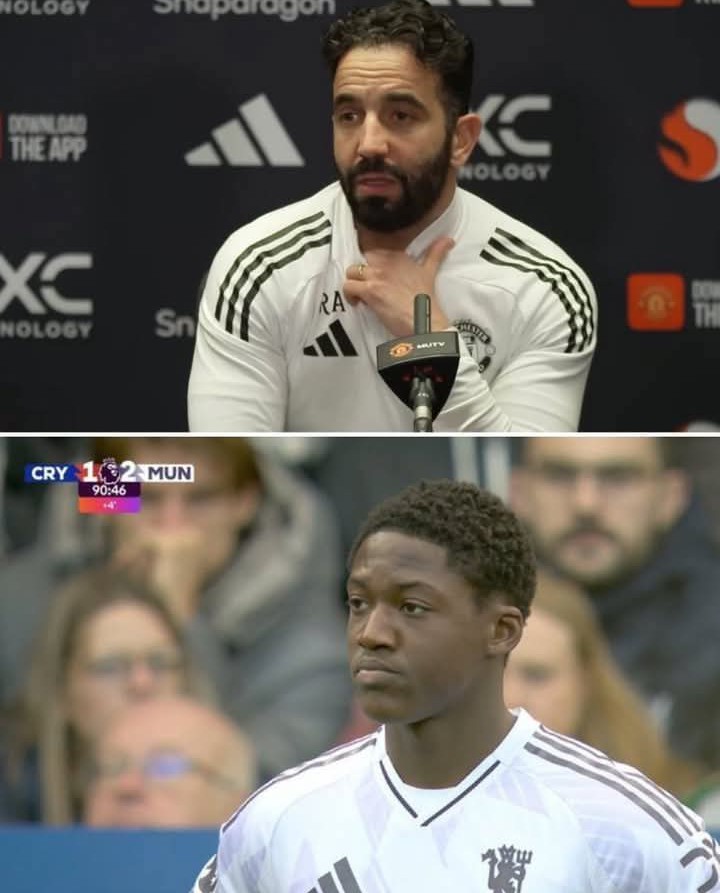
Rúben Amorim Explains Why He’s Not Playing Kobbie Mainoo
Manchester United manager Rúben Amorim has addressed ongoing questions surrounding his decision not to start young midfielder Kobbie Mainoo, offering a firm but measured explanation that has done little to cool debate among supporters. Mainoo, who has rapidly established himself as one of England’s most promising midfield talents and is already a regular for the national team, has found his club minutes unexpectedly limited under Amorim — a situation many fans view with rising frustration.
Speaking to the media, Amorim appeared visibly tired of the repeated inquiries. “You ask me always the same thing,” he said. “I understand what you are saying. You love Kobbie. He starts for England, but that doesn’t mean I need to put Kobbie when I feel I shouldn’t put Kobbie.” His response, intended to draw a line under the discussion, instead sparked fresh debate about selection choices, tactical decisions, and the role of youth in United’s midfield.
The core of the tension lies in United’s current midfield structure. Amorim has frequently opted to play individuals who are not natural central midfielders in roles that require positional discipline, defensive awareness, and ball-progression qualities Mainoo provides. This imbalance has been evident in several matches where United have struggled to control games, often allowing even lower-table opponents to transition through midfield with worrying ease. Critics argue that Mainoo’s absence exacerbates these issues and that his technical confidence, press resistance, and composure make him uniquely suited to stabilizing United’s structure.
However, Amorim’s perspective is more complex. From his point of view, team selection is based on tactical principles, match-specific plans, and the developmental pacing of a young player still early in his professional journey. Managers must balance immediate results with long-term growth, and Amorim may believe that Mainoo benefits more from being eased into certain match profiles rather than deployed indiscriminately. He may also feel that other players currently fit the tactical instructions more closely, even if they do not naturally occupy the central-midfield role.
Still, frustration among supporters is understandable. Mainoo has shown remarkable maturity on the pitch, and his performances for England serve as a constant reminder of the level he is capable of reaching. When a player excels internationally yet struggles for minutes at club level, fans naturally question the logic behind managerial decisions. Some supporters have even begun to speculate that the treatment of Mainoo feels “personal,” a sentiment born more from emotion than evidence but nonetheless reflective of the growing disconnect between fan expectations and Amorim’s choices.
It’s also important to acknowledge that Mainoo, like all young players, has experienced difficult performances. Supporters sometimes forget that his development is ongoing, and the expectation for him to be flawless every week is unrealistic. Amorim’s insistence on context — and his irritation at repeated questioning — suggests he sees a larger picture than what unfolds on matchdays alone.
For now, the relationship between Amorim’s tactical plans and Mainoo’s role remains one of the most intriguing storylines at Manchester United. Whether the young midfielder returns to a regular starting position soon or continues to be managed carefully, the debate around his usage will likely persist — driven by both his exceptional potential and the fans’ deep belief in what he brings to the team.