“Why Jimmy Kimmel’s Teary Non-Apology Earned Applause — and What It Reveals About the Left’s Alternate Universe”
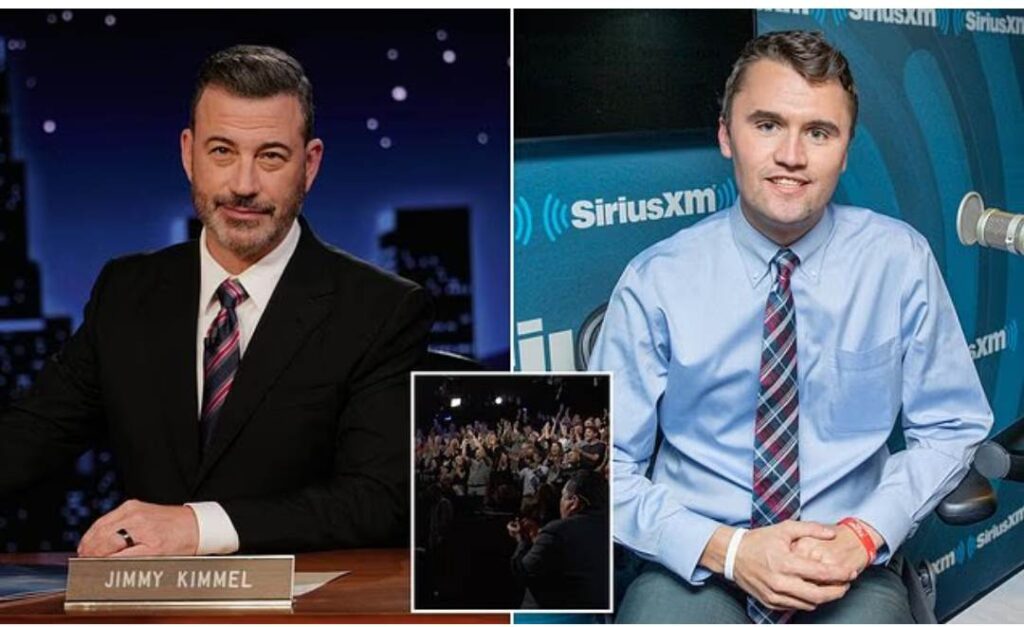
Jimmy Kimmel’s latest monologue has once again ignited controversy — but this time, not for what he said, but for what he didn’t. Following backlash over his remarks connected to conservative commentator Charlie Kirk’s death, the late-night host addressed the issue in an emotional segment that brought him to tears. Yet notably, he stopped short of issuing a direct apology. Instead, Kimmel insisted that he “never intended” to make light of Kirk’s passing, a clarification that drew cheers and applause from his studio audience.
The moment immediately divided the public. Critics argue that the rousing ovation Kimmel received was emblematic of what Mark Halperin describes as “the Left’s alternate universe” — a political and cultural ecosystem where accountability is selective, and double standards thrive.
Halperin points out that if a conservative comedian had handled such a sensitive issue in a similar way, the reaction would have been far less forgiving. “Imagine a Fox News personality making a questionable joke about a progressive activist’s death,” Halperin argued. “The media would demand resignations, apologies, and consequences. Instead, Kimmel was celebrated for a non-apology.”
Indeed, Kimmel’s refusal to directly say “I’m sorry” has fueled accusations of hypocrisy. Some see his emotional display as a calculated move — offering just enough vulnerability to earn sympathy, while carefully sidestepping responsibility. Supporters, however, view the moment differently, framing Kimmel as a comedian caught in a storm of political weaponization, punished for simply trying to navigate the complexities of comedy in a polarized age.
The applause itself has become a focal point in the debate. For critics, it symbolized a lack of genuine accountability, suggesting that partisan loyalty outweighs universal standards of respect and decency. For supporters, it reflected solidarity with a beloved host under fire, proof that audiences still see Kimmel as a voice of authenticity in late-night TV.
The controversy comes at a fragile moment for late-night television as a whole. Ratings have been slipping across networks, and the once-comfortable dominance of hosts like Kimmel, Stephen Colbert, and Jimmy Fallon has been challenged by the rise of digital media, podcasts, and politically independent commentators. In this environment, moments like Kimmel’s teary speech are scrutinized not only for their content but also for what they reveal about the cultural bubble surrounding mainstream comedy.
Halperin’s sharp critique underscores a broader conversation about media bias, double standards, and the blurring lines between entertainment and activism. The fact that Kimmel’s non-apology was greeted with cheers rather than criticism, he argues, is less about comedy and more about tribalism. “It’s not about right or wrong,” Halperin said, “it’s about who is saying it — and which side of the aisle they’re on.”
As the dust settles, one thing is clear: Kimmel’s teary moment won’t soon be forgotten. Whether remembered as a heartfelt clarification or a glaring example of selective outrage, it has once again cemented his role as both a lightning rod and a mirror for America’s deep cultural divides.