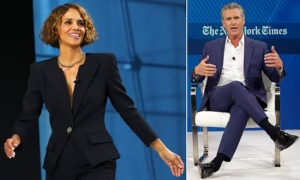
Bill Maher Slams Jimmy Kimmel’s Wife After She Issued Trump Ultimatum to Family
Bill Maher is no stranger to weighing in on political divides, but the HBO host found himself taking aim at an unexpected target this week: Molly McNearney, the wife of late-night host Jimmy Kimmel. McNearney, who also serves as the longtime executive producer of Jimmy Kimmel Live!, recently revealed that she had confronted members of her own family over their support for former President Donald Trump—an admission that set off a wave of commentary across political and entertainment circles. Maher, never shy about poking at what he sees as excesses on the political left, added his voice by criticizing both the tactic and the mindset behind it.
The issue surfaced after McNearney discussed her strained family relationships on a podcast, explaining that she had emailed relatives before the 2024 election with a list of reasons she believed they should not vote for Trump. She described the message as a heartfelt plea rooted in concern for her family, her values, and the welfare of the country. But she acknowledged that some relatives felt attacked, and that the episode left some relationships fractured.
On his show Real Time, Maher didn’t hold back. He argued that while political disagreements are inevitable, issuing what amounts to an ultimatum—demanding family members vote a certain way or risk alienation—is a misguided approach that ultimately fosters resentment. According to Maher, such attempts at controlling the political behavior of others reflect a larger cultural problem: an increasing intolerance for ideological differences and a tendency to moralize political disagreements.
Maher framed the situation as emblematic of what he sees among some progressives who conflate political choices with personal virtue. He acknowledged that there are plenty of reasons someone might vehemently oppose Trump but insisted that trying to coerce loved ones into agreement undermines genuine dialogue. In his view, ultimatums don’t win people over; they just create deeper divides.
He also suggested that McNearney—and others who take a similar approach—should consider why tens of millions of Americans continue to support Trump. Rather than assuming nefarious motives or intellectual shortcomings, Maher argued that trying to understand their perspective would lead to more productive conversations, and perhaps even more persuasive arguments.
McNearney, for her part, had spoken emotionally about how painful it felt to see relatives vote for someone she believes represents values at odds with her own family’s. She said it wasn’t merely about politics but about what she perceived as a moral stance. Her comments resonated with many Americans who have experienced similar rifts within their own families.
Maher’s critique adds another layer to an already complicated national conversation: how do you maintain relationships when political differences feel existential? His message—criticizing ultimatums and encouraging curiosity over condemnation—echoes a theme he’s returned to throughout his career: the need to preserve space for disagreement without turning political divisions into personal warfare.
Whether McNearney responds publicly remains to be seen, but the debate sparked by her story shows no signs of fading.