Halle Berry explodes at Gavin Newsom for ‘devaluing women’ as she declares he ‘should NOT be president’
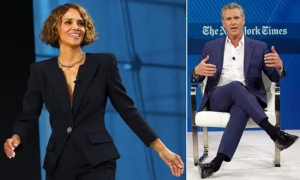
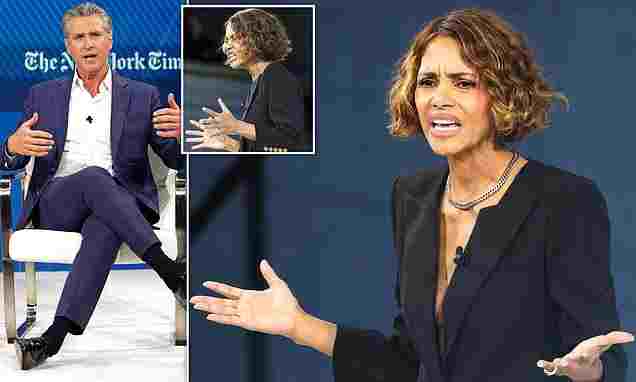
Actress Halle Berry has publicly criticized California Governor Gavin Newsom for what she sees as a pattern of “devaluing women,” going so far as to declare that he “should not be our next president.” The remarks came during a speaking engagement at the DealBook Summit, where Berry addressed issues related to women’s health, leadership, and political accountability. Her comments have immediately sparked debate in both political and entertainment circles.
Berry’s criticism centers on Newsom’s recent veto of the Menopause Care Equity Act, a bill designed to improve access to menopause care and support for women across California. The legislation, which Berry publicly supported, aimed to make workplace and healthcare accommodations for women experiencing menopause more standardized and accessible. By vetoing the bill, Newsom drew ire from advocates who argue that such decisions reflect a disregard for women’s health issues. Berry described the veto as a “disservice” to women, asserting that leaders in power have a responsibility to uplift, not marginalize, female constituents.
In her speech, Berry emphasized the broader implications of political leadership, stating that a politician’s actions toward women are indicative of their overall respect for human rights and equity. “We have to hold leaders accountable,” Berry said. “If someone consistently devalues women, it is difficult to trust them with the highest office in the land.” Her words resonated with activists and constituents who have long criticized policymakers for ignoring gender-specific issues in healthcare, workplace policy, and political representation.
The actress also touched on her personal connection to advocacy, noting that as a woman in Hollywood, she has witnessed systemic inequality and the marginalization of women’s voices. Berry connected her experiences in the entertainment industry to the broader societal patterns she sees in politics, arguing that dismissing women’s needs in any sector contributes to a culture of inequity. Her fiery comments toward Newsom were framed not just as a critique of a single decision, but as part of a larger push for leaders who actively champion women’s rights and health.
Berry’s remarks have sparked a wave of reactions across social media and news outlets. Supporters praised her for speaking out and using her platform to highlight women’s issues, while critics argued that targeting a political figure in such strong terms could be polarizing. Regardless of the reaction, Berry’s statements underscore the increasing expectation that public figures — both political and cultural — address gender equity with intentionality and care.
The Menopause Care Equity Act itself remains a contentious topic in California politics, with advocates continuing to push for improved legislation and public awareness. Berry’s vocal opposition to Newsom’s veto has amplified national attention on the bill, prompting discussions about women’s healthcare policy and the role of leaders in fostering gender equality.
As the 2026 election cycle approaches, Berry’s declaration that Gavin Newsom “should not be our next president” may influence public perception, particularly among voters concerned with women’s rights and healthcare. Whether her comments will have a lasting impact on Newsom’s political ambitions is uncertain, but they have undeniably thrust the conversation about women’s health, leadership, and accountability into the national spotlight.
Berry’s remarks are a reminder of how celebrities are increasingly using their visibility to engage with political discourse, particularly around issues affecting women, and how those statements can reverberate beyond the entertainment industry.