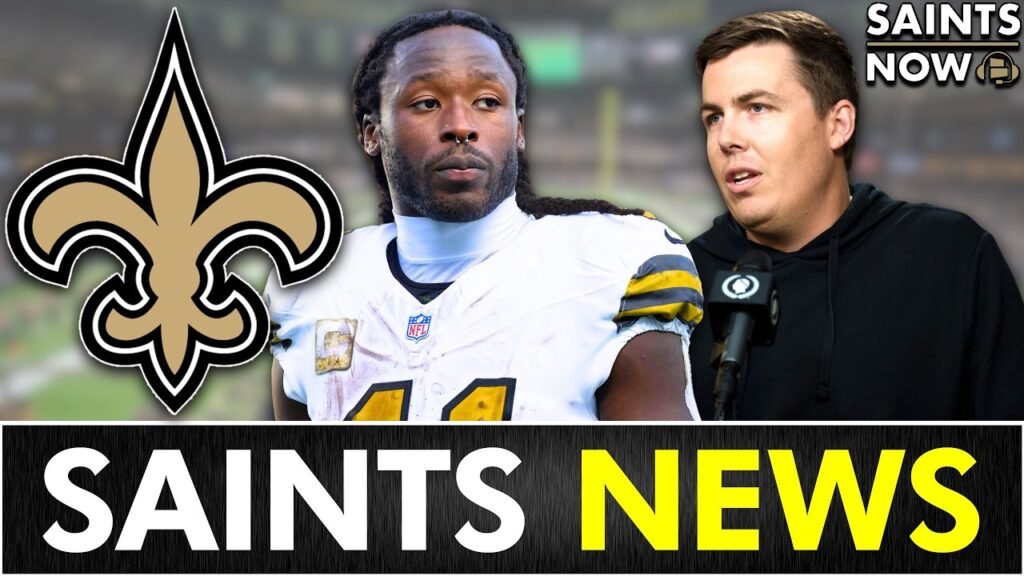
Kellen Moore’s Blunt 7-Word Take on Saints’ Alvin Kamara Situation
METAIRIE, La. – Amidst a swirl of offseason uncertainty surrounding veteran running back Alvin Kamara’s future with the New Orleans Saints, head coach Kellen Moore has finally broken his silence with a characteristically blunt assessment. When pressed by reporters on the running back’s roster security following the blockbuster signing of Travis Etienne, Moore delivered a seven-word response that spoke volumes about the current state of the franchise: “I don’t know the business, contractual side.”
That terse admission, offered during a press conference this week, encapsulates one of the most awkward and closely-watched standoffs of the NFL offseason. For a player who has spent nine seasons in Black and Gold and is the franchise’s all-time leading rusher, the road to the 2026 regular season is suddenly littered with financial hurdles, a crowded backfield, and a youth movement.
The Arrival of Etienne
The tension in New Orleans began in March when the Saints shocked the NFL landscape by signing former Jacksonville Jaguars running back Travis Etienne to a massive four-year, $52 million contract. The move signaled a potential changing of the guard in the backfield. While Etienne represents explosive youth, it left Kamara, 30, in a precarious position as he attempts to come back from the worst statistical season of his career.
In 2025, Moore’s first year as head coach, Kamara appeared in only 11 games. Plagued by knee and ankle injuries that forced him to miss the final six contests, he recorded a career-low 471 rushing yards and just one touchdown on the ground, adding 33 receptions for 186 yards. It was a steep decline for a player who had consistently been one of the most dangerous dual-threat weapons in the league.
Despite the signing of Etienne and the drafting of other young backs, Moore insisted that he sees a role for the veteran. When asked about the offensive fit, the coach expressed genuine enthusiasm.
“He can fit in really well from an offensive standpoint,” Moore said. “As you navigate some of the business stuff, signing Travis, kind of navigating how all these pieces work together, I think that’s always a little bit of a challenge as you’re building your roster.”
However, Moore has made it clear that his expertise lies on the grass, not in the accounting department. His repeated refrain of “I don’t know the business side” highlights a specific dynamic in New Orleans where the coaching staff and the front office are not entirely on the same page regarding the veteran’s fate.
A Change in Attitude
Perhaps the most significant development in this saga is a subtle shift in Kamara’s own behavior. Historically, the five-time Pro Bowler has used the voluntary offseason program as a time to train privately in Miami, usually avoiding the facilities until mandatory minicamps. He was notably absent for most of May, with Moore noting that the running back was one of four veterans—alongside Nathan Shepherd, Zach Wilson, and Ryan Wright—not participating in the early OTAs due to “personal reasons”.
However, on Wednesday, June 3, the tone changed. Kamara walked through the doors of the Saints facility, marking his first attendance at the voluntary OTAs in recent memory. Moore confirmed the presence, noting that the running back had arrived just in time for the team meeting.
“Alvin got here today. He’s here. So, we’ll kind of work through an acclamation process there, getting to work with him,” Moore told reporters. “It’s good to see him. Obviously, a lot of times this time of year he’s not always here — similar to last year. So, it’s good to see him and excited to spend a little bit of time talking with him, seeing where he’s all at.”
For a player facing questions about his future and his health, showing up was a strategic decision. Kamara addressed the media following his return, and in a departure from the usual cliches, he struck a philosophical and mature tone regarding the business realities of the NFL.
“I’ve been through a lot in my life. I’ve learned not to take things personal. I’m blessed,” Kamara said, via The Times-Picayune. “I’m here. I’m gonna do what I’ve got to do… I’m doing the same thing I do every year, training. I’m gonna be ready, and we’ll see what happens.”
His agent, Brad Cicala, had already laid the groundwork for this stance days earlier, telling NFL Network’s Mike Garafolo, “We plan on playing for the Saints in 2026,” while clarifying that there is no formal trade request on the table.
The Financial Reality
Moore’s ignorance of the “contractual side” is plausible, given the labyrinthine nature of Kamara’s current deal. The financial logistics make a simple resolution difficult.
According to salary cap experts, Kamara carries a $10.5 million cap hit for the 2026 season, though only $3 million of his salary remains fully guaranteed. Because of an unconventional restructure the team executed in March, Kamara is ineligible to be designated as a post-June 1 cut. If the Saints were to release him outright today, they would save a paltry $400,000 against this year’s cap—hardly the kind of savings that justify losing a franchise icon, even a diminished one.
General Manager Mickey Loomis has been characteristically cryptic, referring to the situation as a “resource management element” and admitting the team is “trying to see how [Kamara is] gonna fit on our roster”.
Many analysts believe the most likely outcome is a restructured pay cut. The Saints could ask Kamara to reduce his salary to remain with the team as a complementary piece to Etienne, or they could simply hold onto him for 2026 and let him walk in free agency, absorbing the dead cap hit in 2027.
The Retirement Card
There is, however, a nuclear option that hangs over these negotiations: retirement. Earlier in the offseason, speculation ran rampant that if the Saints attempted to trade him to a team he did not approve of, Kamara would simply hang up his cleats rather than uproot his life.
Moore has been hesitant to wade into those waters. During a press conference in March, when asked directly if the star running back was considering retirement, Moore gave an even shorter answer than his recent seven-word quip.
“Uhhh… I’m not gonna get into all of that stuff,” Moore said at the time.
For now, the “business side” remains unresolved. With mandatory minicamp on the horizon and training camp set to begin in late July, the Saints have a limited window to decide whether Kamara is the future of the backfield, a veteran mentor to Etienne, or a cap casualty who will be remembered as one of the greatest to ever wear the uniform.
Until then, as Moore stands on the practice field watching the drills, he is content to let the agents and the front office fight over the dollars.
“It was good to see him,” Moore reiterated. “Fired up for that and excited to kind of build from here.”