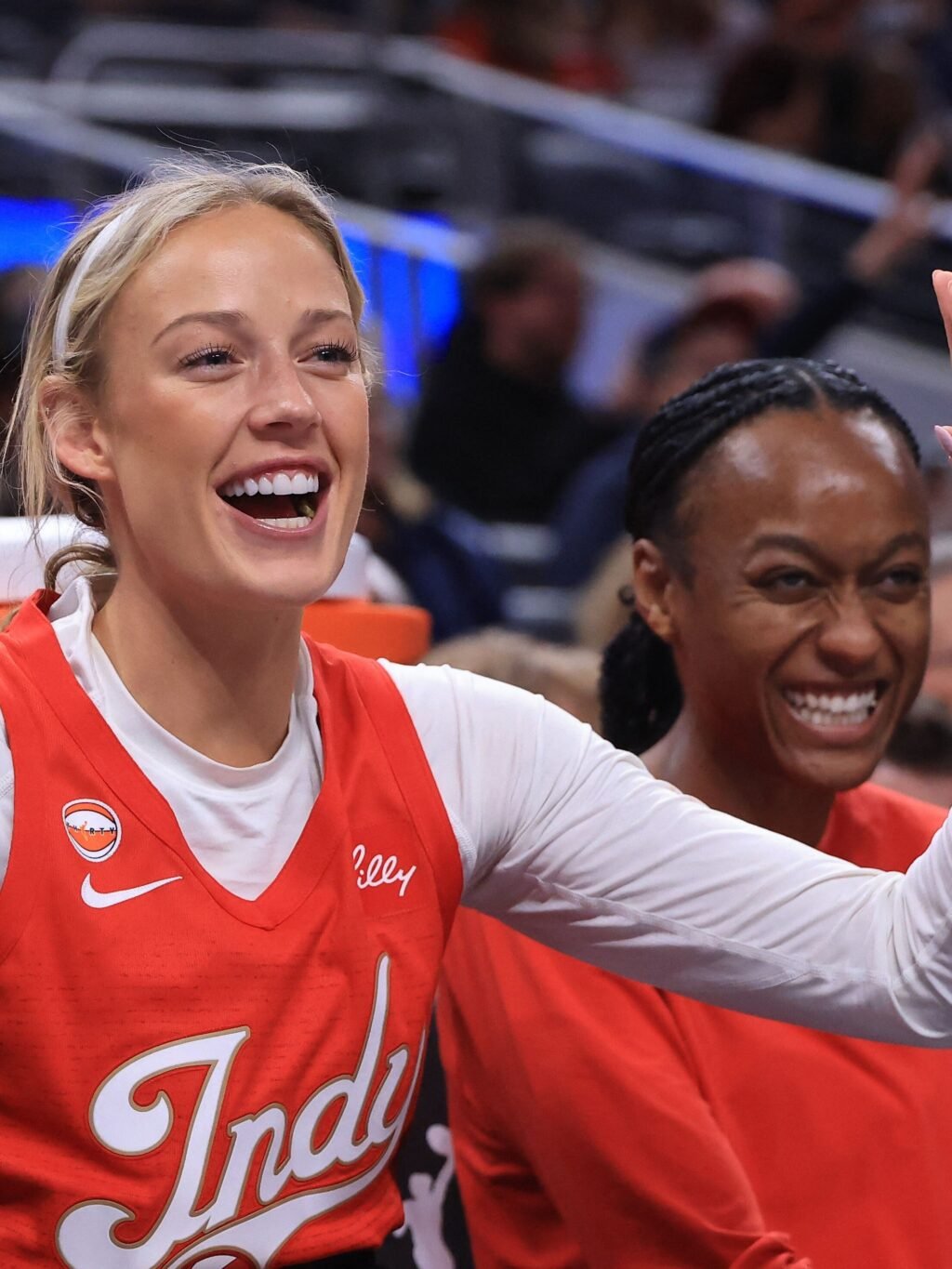
Sophie Cunningham didn’t hesitate when asked what stands between the Indiana Fever and a WNBA championship. The answer wasn’t about Caitlin Clark’s turnovers, Kelsey Mitchell’s shot selection, or the team’s ability to handle playoff pressure. It was about something far more fundamental—and far more difficult to fix in the final weeks of a season.
Defense.
“Defensively, we struggle. We’re like 11th or 10th, and that’s not good whatsoever,” Cunningham said on The Colin Cowherd Podcast. “Yes, we’re able to outscore opponents, but playoffs are a different ballgame.”
The Numbers Behind the Concern
Cunningham’s assessment isn’t just a veteran’s gut feeling. The statistics paint a stark picture of a team with a historic offense and a pedestrian defense.
Indiana boasts the WNBA’s best offensive rating at 116.5 and leads the league in scoring at 97.0 points per game. The Fever’s star duo of Kelsey Mitchell and Caitlin Clark ranks among the league’s top scorers, with Mitchell averaging 25.0 points and Clark contributing 22.5 points and a league-leading 8.4 assists per game.
But the defensive numbers tell a different story. Indiana’s defensive rating of 109.2 ranks 11th in the 13-team league. That’s not just mediocre for a playoff team—it’s historically problematic for a title contender.
“I know in the W… I’m pretty sure the last six teams who have won it, they’ve all been top three or four, maybe besides one, in defense… and we’re just not there,” Cunningham said.
The Scramble Rotation Problem
On her podcast No Hesitation with trainer Drew Hanlen, Cunningham went deeper into the mechanical failures behind Indiana’s defensive struggles. She identified two specific issues: scramble rotations and defensive rebounding.
“Our scramble rotation and then our box-out and rebounding really kind of screws us,” Cunningham said. “Our biggest struggle, and we talk about this all the time, is like it’s very rare for all five of us out on the court to be on a string.”
That lack of connectivity—the “string” that connects all five defenders—is what separates elite defenses from average ones. Cunningham explained that defending one-on-one in the WNBA requires at least one and a half steps of help from teammates, but the Fever have struggled to rotate consistently.
“There’s always one person who is just kind of ball watching or not doing what they’re supposed to do,” she added.
The Rebounding Concern
For all the attention on Indiana’s offensive firepower, Cunningham pointed to a less glamorous area that concerns her: defensive rebounding and boxing out. While Aliyah Boston and Makayla Timpson have provided some strength on the defensive glass, the team’s overall rebounding discipline remains inconsistent.
This matters particularly in the playoffs, where possessions become more precious and second-chance points can swing a series. The Fever’s ability to finish defensive possessions with rebounds will be tested against teams like the Minnesota Lynx, who have already secured the No. 1 seed and boast a more balanced roster.
The Experience Factor
Cunningham isn’t just identifying a problem—she’s also pointing to a reason for optimism. Indiana’s roster has accumulated meaningful playoff experience over the past two seasons, and the team’s core has grown together through adversity.
“We have the experience,” Cunningham said. “We definitely have all the offensive threats you could ask for. We’re a dangerous team, but again, there’s a lot of dangerous teams. So, it’s the little details.”
The “little details” Cunningham references are precisely what separate regular-season success from playoff advancement. In a seven-game series, opponents have time to exploit weaknesses. If Indiana’s defense remains a liability, teams will scheme to force stops and make the Fever’s offense work harder for every point.
The Path Forward
The Fever return to action September 18 against the Toronto Tempo, followed by a game against the Washington Mystics and two critical matchups against the Minnesota Lynx. These final four games represent a compressed window to address defensive issues before the playoffs begin September 27.
Cunningham believes the challenge is as much mental as it is physical.
“We don’t have time anymore,” she said. “You’re either going to do it, or you’re not. And I think these four games, it’s got to be a defensive mindset so we can set ourselves up for where we want to be when the season’s over.”
The message is clear: Indiana’s offense has already proven it can win games. Whether the Fever can win a championship depends on whether they can find the defensive consistency that has eluded them all season. As Cunningham put it, if they can just get “a little bit better defensively,” the Fever become a team no one wants to face in the playoffs.
For Indiana, the margin between contender and champion may be measured not in points scored, but in stops earned.