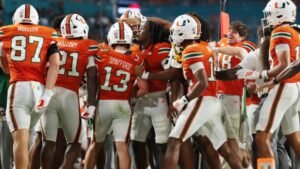
one of the most legendary pipelines in football history. The relationship between the University of Miami Hurricanes and the Dallas Cowboys represents one of the most culturally significant and historically impactful intersections of collegiate and professional football. On the surface, they exist in entirely different universes: one is a private research university in South Florida competing in the NCAA’s Atlantic Coast Conference, while the other is a multi-billion-dollar global sports franchise based in North Texas, competing in the National Football League. Yet, during the late 1980s and the 1990s, the boundaries between Coral Gables and Dallas blurred. Driven by shared coaching leadership, a specific scouting philosophy, and a revolutionary sense of confidence, “The U” became the primary incubator for the team that would come to define the modern NFL: “America’s Team.”
### The Architect: Jimmy Johnson’s Blueprint
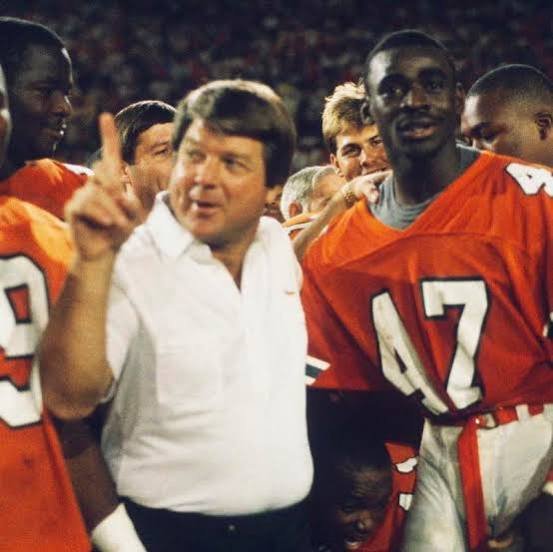
The foundational bridge between Miami and Dallas was built by a single man: Jimmy Johnson. Johnson arrived at Miami in 1984, inheriting a program that had recently won its first national championship under Howard Schnellenberger. Johnson did not just maintain the winning culture; he evolved it into a cultural phenomenon. His Miami teams were defined by breathtaking speed, aggressive defensive schemes, and an unapologetic swagger that polarized the college football world. Under Johnson, the Hurricanes went 52-9 over five seasons, culminating in an undefeated 1987 National Championship season.
In 1989, when billionaire Jerry Jones purchased the Dallas Cowboys, his very first move was to fire legendary coach Tom Landry and hire his former Arkansas Razorbacks teammate, Jimmy Johnson. Jones gave Johnson complete control over football operations. Johnson inherited a depleted 1-15 Cowboys squad and immediately set out to rebuild them using the exact blueprint he perfected in Coral Gables.
Johnson understood that the NFL of the 1990s was changing. He valued speed and athleticism over raw size—a philosophy he honed while recruiting South Florida’s elite high school talent. If a player was fast enough to play linebacker in Johnson’s system, he was often converted into a defensive lineman. If a safety had elite coverage speed, he became a cornerback. Johnson imported this exact talent-evaluation metric to Dallas, fundamentally shifting how NFL rosters were constructed.
### The Playmaker: Michael Irvin as the Soul of Two Franchises
If Jimmy Johnson was the architect of the Miami-Dallas pipeline, wide receiver Michael Irvin was its living, breathing embodiment. Known universally as “The Playmaker,” Irvin was the emotional heartbeat of the 1987 Miami Hurricanes national championship team. He left Coral Gables holding nearly every major receiving record in school history, but more importantly, he established the standard of work ethic and vocal leadership that defined “The U.”
The Cowboys drafted Irvin with the 11th overall pick in the 1988 NFL Draft, one year before Johnson’s arrival. When Johnson took over the Cowboys in 1989, Irvin became the vital bridge between the coach and the rest of the locker room. Irvin understood Johnson’s demanding style, his psychological tactics, and his intolerance for mediocrity.
In Dallas, Irvin replicated the exact standard of excellence he learned at Miami. His legendary, hyper-competitive practices elevated the work ethic of teammates like Emmitt Smith and Troy Aikman. Together, they formed “The Triplets.” Irvin’s swagger, gold chains, and high-profile persona mirrored the identity of the 1980s Hurricanes, translating that college energy seamlessly onto the professional stage. When the Cowboys won three Super Bowls in four years (1992, 1993, and 1995), Irvin was the spiritual leader, cementing his place in the Pro Football Hall of Fame as a champion at both levels.
### The Brain Trust: Butch Davis and Coaching Continuity
The operational relationship between the two programs extended far beyond the head coach. Defensive mastermind Butch Davis served as Johnson’s defensive line coach and recruiting coordinator at Miami from 1984 to 1988. He was the man responsible for identifying the overlooked, hyper-athletic players that fueled the Hurricanes’ defensive dominance.
When Johnson left for Dallas, Davis followed him, serving as the Cowboys’ defensive line coach and eventually upgrading to defensive coordinator. Under Davis’s guidance, the Cowboys’ defense transformed into a fast, swarming unit that terrorized opposing quarterbacks, mirroring the Hurricanes’ “Miami Vice” style of defense. Davis’s schemes were instrumental in Dallas capturing Super Bowls XXVII and XXVIII.
The pipeline came full circle in 1995. After the Cowboys’ championship run and Johnson’s departure from Dallas, the University of Miami faced severe NCAA sanctions and was looking for a savior to rebuild the program. They turned back to the Dallas coaching tree, hiring Butch Davis as their new head coach. Davis used his NFL credibility and the scouting acumen he sharpened in Dallas to rebuild the Hurricanes from the ground up. His recruiting classes in the late 1990s laid the groundwork for the 2001 Miami Hurricanes, widely considered one of the greatest college football teams ever assembled.
### The Roster Pipeline: From Coral Gables to Irving
Driven by Johnson’s familiarity with his former players and Davis’s scouting eye, the Cowboys actively targeted Miami alumni to fill out their championship rosters. This created a unique locker room culture in Dallas where the standard of “The U” became the standard of the NFL.
Beyond Michael Irvin, several key contributors wore both the orange and green of Miami and the silver and blue of Dallas:
* **Russell Maryland:** The dominant defensive tackle was the foundational piece of Johnson’s Miami defense, winning two national titles and the 1990 Outland Trophy. Trusting his former star implicitly, Johnson made Maryland the No. 1 overall pick in the 1991 NFL Draft for the Cowboys. Maryland became a cornerstone of the Cowboys’ defensive line during their three Super Bowl runs.
* **Leon Lett:** While Lett did not play his college ball at Miami (he attended Emporia State), he was discovered by Butch Davis using the exact scouting metrics Davis used to find talent for the Hurricanes. Lett became a Pro Bowl defensive tackle for the Cowboys, embodying the athletic, disruptive interior lineman archetype.
* **Alonzo Highsmith & Randal Hill:** Other former Hurricanes skill-position players transitioned through the Dallas roster during this era, ensuring that the competitive, vocal, and ultra-confident Miami culture remained dominant in the Cowboys’ facility.
### A Lasting Cultural Synergy
The legacy of the Miami-Cowboys connection is defined by how both programs altered the cultural landscape of football. Prior to the late 1980s, the NFL was largely a conservative, corporate league. The Dallas Cowboys under Tom Landry were the epitome of this corporate image—stoic, structured, and predictable.
By injecting the raw emotion, swagger, and schematic innovation of the Miami Hurricanes into the Dallas Cowboys, Jimmy Johnson and Michael Irvin reinvented “America’s Team.” They proved that a team could play with extreme emotion, express individual personality, and still maintain the disciplined execution required to win championships at the highest level.
Though decades have passed since the peak of this pipeline, the historical bond remains unbreakable. The connection between the Miami Hurricanes and the Dallas Cowboys stands as a premier example of how a collegiate football culture can rise to the professional ranks and reshape a dynasty in its own image.