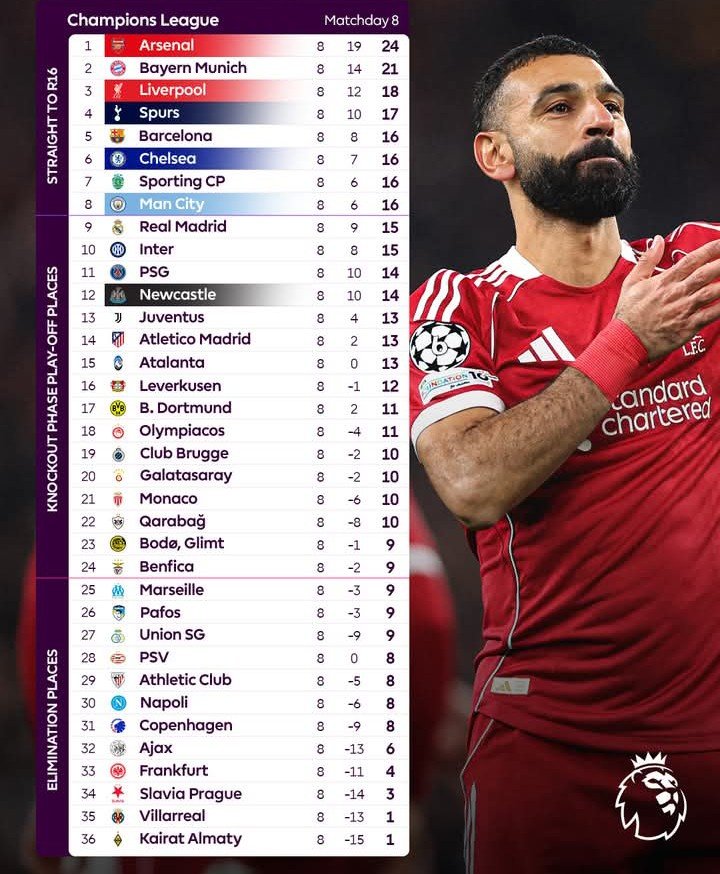
The Final Champions League Group Phase Standings as Five Premier League Teams Go Straight Through to the Round of 16
The Champions League group phase has come to an end, and it has been a statement-making campaign for English football. As the dust settles on the final standings, five Premier League clubs have booked their place directly in the Round of 16, underlining the league’s growing dominance on the European stage.
Under the new Champions League format, consistency across the group phase has never been more important. With fewer safety nets and tighter margins, finishing in the top positions of the table carries significant value — and Premier League sides have risen to the challenge.
Arsenal were among the standout performers, navigating their group with authority and maturity.
Their progression reflects a side that has grown comfortable handling European pressure, blending tactical discipline with attacking intent. Liverpool followed closely, combining experience with intensity, reminding Europe why they remain one of the competition’s most feared teams when momentum builds.
Manchester City, despite moments of inconsistency, once again showed their ability to control games at the highest level.
Their qualification felt inevitable, built on composure, squad depth, and an understanding of how to manage European nights. Chelsea, meanwhile, quietly did their job. Without excessive noise or drama, they accumulated results efficiently and ensured safe passage into the knockout stages.
Tottenham Hotspur’s progression perhaps surprised some, but it highlighted their growing adaptability. Spurs balanced domestic demands with continental ambition, showing resilience in tough fixtures and earning their place among Europe’s final 16.
For the Premier League, the significance goes beyond individual clubs. Five teams progressing directly sends a powerful message about the league’s overall quality, depth, and competitiveness. The physical intensity, tactical variety, and relentless pace of English football continue to translate effectively onto the European stage.
Not every English side enjoyed a smooth journey. Newcastle United, despite flashes of brilliance, fell just short of direct qualification and now face the uncertainty of the playoff route. Their experience, however, will serve as a valuable lesson for a club still re-establishing itself in elite European competition.
Elsewhere in Europe, traditional heavyweights felt the pressure. Several established clubs were forced into playoff spots or eliminated altogether, emphasizing how unforgiving the modern Champions League has become. Reputation alone is no longer enough — adaptability and squad depth are essential.
As attention now turns to the knockout stages, the presence of five Premier League clubs adds intrigue and expectation. With domestic rivals potentially colliding on the European stage, the narrative shifts from qualification to ambition. The question is no longer whether English teams belong at this level — it’s how many can realistically go all the way.
For fans, the Round of 16 promises drama, tension, and high-quality football. For the Premier League, it’s validation. Five teams through, Europe watching, and the knockout phase set for another chapter in an increasingly English-flavoured Champions League story.