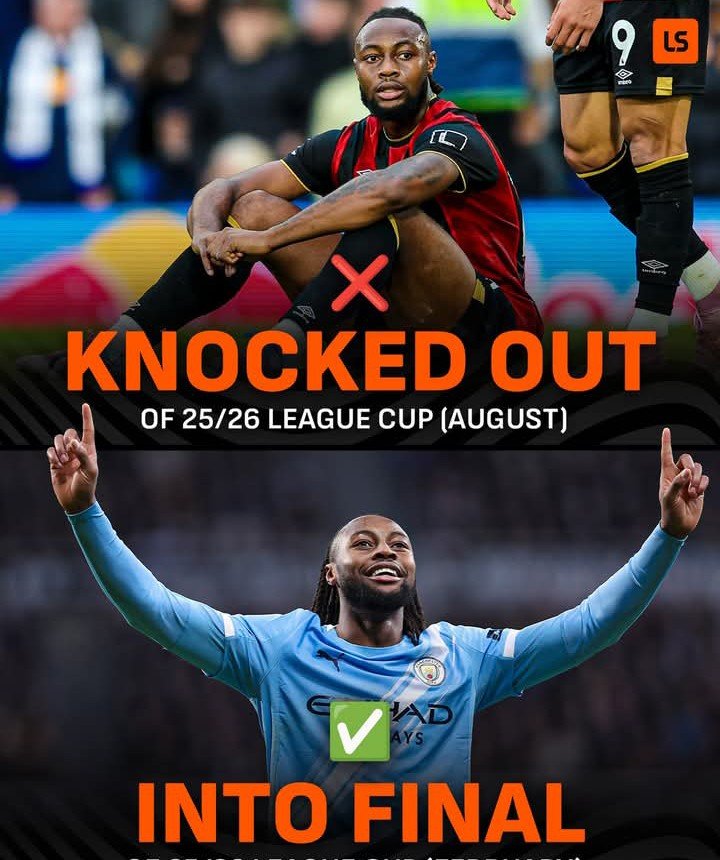
Antoine Semenyo Knocked Out and Reaches League Cup Final in Same Season After Rule Change
Football rarely produces moments as bizarre as this, but Antoine Semenyo has found himself on both sides of the League Cup storyline in the same campaign — eliminated and yet a finalist — thanks to a modern rule change that continues to reshape domestic competitions.
The Bournemouth forward has experienced one of the strangest seasons in recent League Cup history, becoming a talking point among fans after it emerged that he has technically been knocked out of the competition while also reaching the final. While it may sound impossible at first glance, the situation is entirely legitimate under the current EFL Cup regulations.
The confusion stems from changes to the “cup-tied” rules. In previous seasons, players who featured for one club in the League Cup were barred from representing another team in the same competition if they transferred mid-season. That restriction has since been removed. Under the updated rules, players are allowed to play for more than one club in the League Cup during a single campaign, even if one of those teams has already been eliminated.
This is where Semenyo’s unique scenario comes into play. Having featured earlier in the competition for one side that was eventually knocked out, he later became part of a squad that progressed all the way to the final. As a result, he now finds himself eligible for a League Cup winners’ medal — despite having already suffered elimination earlier in the same tournament.
While the situation may feel strange, it is far from unprecedented in modern football. The rule change was introduced to reflect the realities of the transfer market, where players move clubs more frequently and often during the middle of cup competitions. The aim was to reduce unnecessary restrictions on squad depth and ensure clubs are not unfairly punished for signing players who have already appeared elsewhere.
Still, Semenyo’s case highlights how unusual the optics can be. From a fan’s perspective, it challenges the traditional logic of knockout football, where elimination is supposed to be final. Instead, the focus now lies on club progression rather than individual participation.
Reaction online has been mixed. Some supporters see it as a harmless quirk of modern football, pointing out that the rule applies equally to all clubs and players. Others feel it undermines the integrity of knockout competitions, arguing that a player should not be able to “re-enter” a tournament after being knocked out, even if the rules allow it.
For Semenyo himself, the situation is largely symbolic. His contribution across the season remains valid, and his eligibility for the final reflects the regulations rather than any loophole exploitation. It also underlines how football governance continues to evolve in response to the modern game’s demands.
As the League Cup final approaches, Semenyo’s story stands as a reminder that football is not just shaped by mom thatents on the pitch, but by the fine print feof the rulebook. In a season full of surprises, being knocked out and reaching the final at the same time may be one of the most eye-catching twists ,,