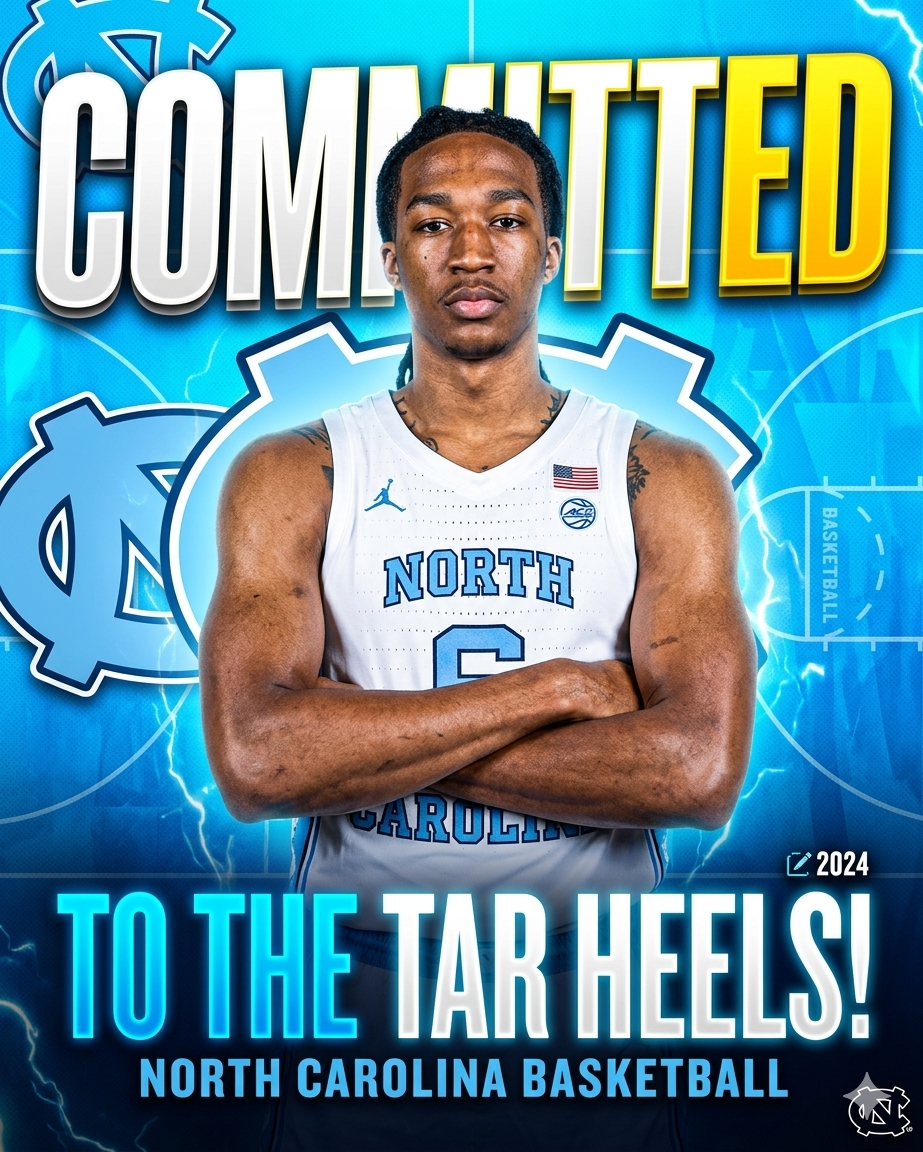
BREAKING: Five-Star Guard Dylan Mingo Flips Commitment to North Carolina Basketball
CHAPEL HILL, NC – In a stunning development that has reshaped the Atlantic Coast Conference recruiting landscape, five-star guard Dylan Mingo has officially flipped his commitment to the University of North Carolina. The 6-foot-5 lead guard from Long Island Lutheran in New York made the announcement Tuesday morning on ESPN’s “First Take,” choosing the Tar Heels over fellow finalists Baylor, Penn State, and Washington .
The commitment marks a seismic shift in the recruiting battle for one of the nation’s premier backcourt prospects and represents a monumental victory for head coach Hubert Davis as he continues to reestablish North Carolina as a destination for elite high school talent. Mingo, rated as high as the No. 5 overall prospect in the 2026 class by the 247Sports Composite, becomes the highest-ranked recruit in the Tar Heels’ incoming class and the program’s second signee, joining four-star wing Maximo Adams (No. 25 overall) .
For a program that has prided itself on producing legendary guards from Michael Jordan to Raymond Felton to Ty Lawson, landing a player of Mingo’s caliber sends a clear message: North Carolina remains a powerhouse on the recruiting trail, even as the college basketball landscape undergoes dramatic transformation.
The Decision: Why Chapel Hill?
In an era where NIL deals and immediate playing time often dictate recruiting decisions, Mingo’s choice was rooted in something far more traditional: the atmosphere, the culture, and the unmistakable aura of the Tar Heel program.
“I chose North Carolina for North Carolina itself,” Mingo said during his announcement on ESPN. “Seeing everything after they won the (Duke) game had a huge impact on my decision. It’s so joyful. The players looked so joyful. If you heard Seth Trimble and Caleb Wilson, if you heard them speak after, they talked about how much they loved their community and loved North Carolina. They would do anything for it” .
The victory over Duke that Mingo referenced—a February 7th triumph that sent the Smith Center into a frenzy—clearly left an indelible impression. But it was more than just a single game. Mingo’s official visit to Chapel Hill in November, where he attended UNC’s win over N.C. Central, provided the foundation for what would become a full-fledged commitment.
“On my visit, I felt how family-oriented everything was,” Mingo explained. “The coaches just made me feel welcomed. The team was super nice. I hung out with the team for a bit. They were all connected. I didn’t feel any animosity. And the legacy of North Carolina, that was a dream of mine since I was a kid” .
That sense of connection was reinforced by UNC’s coaching staff, which included assistants Sean May and Marcus Paige, both of whom were in attendance to watch Mingo as recently as January at the HoopHall Classic . Their persistence paid off, securing a commitment that may well define the trajectory of the program for years to come.
The Player: A Blueprint for Modern Basketball
Mingo isn’t just another five-star recruit—he’s precisely the type of player that modern college basketball demands. At 6-foot-5 with a wingspan stretching 6-foot-10, he possesses the positional size that has become increasingly coveted at the highest levels of the sport . His frame allows him to play either guard spot, defend multiple positions, and crash the glass with the tenacity of a player much larger than his listed 190 pounds.
His statistics from the Nike EYBL circuit tell the story of a player who impacts the game in virtually every facet. Mingo averaged nearly 18 points, eight rebounds, three assists, and two steals per game, numbers that reflect his all-around versatility . He’s a slasher by nature, using his combination of size, speed, and ball-handling to get to the rim with regularity. His ability to navigate ball screens and make reads out of pick-and-roll situations has drawn comparisons to some of the ACC’s most dynamic guards.
“He has the ability to get wherever he wants with the ball in his hands,” said Adam Finkelstein, 247Sports’ Director of Scouting. “Mingo has a tight handle, can break his defender down with combo-moves, navigate a crowded lane instinctively, make reads out of ball-screens, utilize both hands, and create for himself and others. He is also a terrific perimeter rebounder, a very disruptive defender, and simultaneously capable of guarding multiple positions” .
The swing skill for Mingo—and what will ultimately determine his ceiling in college and beyond—is his perimeter shooting. He connected on only 23 percent of his three-point attempts across 13 grassroots games last summer . It’s a statistical red flag that UNC’s coaching staff will undoubtedly work to address, but it’s also an area of significant upside. If Mingo can refine his mechanics and become a consistent threat from deep, he could evolve from a very good player into an All-American caliber talent.
Breaking a Troubling Trend
Mingo’s commitment carries weight beyond his on-court abilities. It represents an opportunity to rewrite a narrative that has followed North Carolina basketball for the better part of a decade: the inability to retain elite guard talent.
Recent history provides a sobering backdrop. Ian Jackson, a top-10 recruit in 2024, transferred to St. John’s after just one season. Elliot Cadeau, the No. 2 point guard in the 2023 class, departed for Michigan. Caleb Love, ranked No. 17 overall in 2020, eventually landed at Arizona . Each arrived in Chapel Hill with immense hype; each left before fulfilling what many believed was their destiny in Carolina blue.
The last five-star guard to begin and end his career at North Carolina was Ty Lawson, a top-five recruit in 2006 who went on to become ACC Player of the Year and lead the Tar Heels to a national championship in 2009 . That’s a drought that spans nearly two decades—a startling statistic for a program that built its identity around legendary backcourt play.
Davis has made it a priority to address this trend, emphasizing culture and connection in his recruiting pitches. Mingo’s decision to commit, and his repeated references to the “family-oriented” nature of the program, suggest that message is resonating. But the real test will come when Mingo arrives on campus, when the initial excitement of commitment gives way to the daily grind of practice, competition, and the inevitable challenges that come with being a freshman at a blue-blood program.
Building a New-Look Backcourt
Mingo’s arrival in Chapel Hill will coincide with significant roster turnover. Senior guard Seth Trimble will be out of eligibility following the 2025-26 season, creating a void in the backcourt that Mingo is ideally suited to fill . He’ll be joined by current freshman Derek Dixon, assuming Dixon remains in the program, creating a potential partnership that could define UNC’s backcourt for years to come.
The combination of Mingo and Dixon—both 6-foot-5 or taller—would give the Tar Heels the kind of positional size that has become a hallmark of elite ACC programs. Duke, under Jon Scheyer, has built its recent success around lengthy, versatile guards who can switch defensively and create mismatches on offense. Davis appears to be following a similar blueprint, and Mingo’s commitment represents a significant step in that direction.
“Mingo is all of 6-foot-5 with a 6-foot-10 wingspan. Adams is a 6-foot-7 wing who can pass, dribble and shoot. If UNC can retain emerging 6-foot-5 freshman point guard Derek Dixon and 6-foot-6 sharpshooter Luka Bogavac, the Tar Heels will boast the most perimeter size the program has seen in years” .
This vision of the future stands in stark contrast to some of UNC’s recent backcourts, which at times struggled with defensive versatility and rebounding. Davis has made clear that he wants length at every position, and Mingo is the embodiment of that philosophy.
The Bigger Picture: ACC in Flux
Mingo’s commitment arrives at a moment of profound transition for the ACC. The conference that for decades was defined by iconic coaching figures has seen a wave of retirements and departures: Roy Williams, Mike Krzyzewski, Jim Boeheim, Tony Bennett, and Leonard Hamilton have all exited stage left in recent years . In their place has come a new generation of coaches, each attempting to carve out their own legacy in one of college basketball’s most demanding environments.
Davis has been part of that transition, taking over a program that Williams built into a national powerhouse. His tenure has had its ups and downs, but the recruiting trail has increasingly become a source of optimism. Mingo gives Davis his fifth five-star commitment overall and represents the program’s longest streak of landing elite prospects since 2008-11 .
The timing is also notable given what’s happening just 25 miles down the road in Raleigh. N.C. State recently hired Will Wade as its new head coach, a move that signaled the Wolfpack’s intention to compete aggressively in the recruiting wars . Wade, who rebuilt McNeese into a 58-win program over two seasons, has a reputation as a relentless recruiter and program builder. His presence in the Triangle adds another layer of intrigue to an already heated in-state rivalry.
North Carolina now ranks third nationally in five-star commitments since 2000, trailing only Kentucky and Duke . It’s a statistic that speaks to the program’s sustained ability to attract elite talent, even as the broader college basketball landscape has shifted dramatically.
What Comes Next
With Mingo secured, the attention turns to the remainder of UNC’s 2026 recruiting class. The Tar Heels continue to pursue several other high-profile targets, including five-star forward Anthony Thompson, a 6-foot-7 wing from Ohio who is rated as high as the No. 9 overall prospect in the class . Thompson took an official visit to Chapel Hill in August and has the Tar Heels among his final seven schools .
There’s also Miika Muurinen, a 6-foot-10 stretch four from Compass Prep in Arizona whose mother played basketball at UNC from 2001 to 2003 . The Finnish national team member has drawn comparisons to some of the most versatile frontcourt players in college basketball and would provide another dimension to a class that is already taking shape as one of the nation’s best.
For now, though, the focus is squarely on Mingo and what his commitment means for a program that has long been searching for its next great guard. He carries the weight of history with him—both the success of those who came before and the departures of those who couldn’t stay. But if his announcement Tuesday was any indication, he’s ready to embrace it.
“The legacy of North Carolina, that was a dream of mine since I was a kid,” Mingo said .
In an era of transfers, NIL deals, and conference realignment, that kind of sentimentality might seem outdated. But in Chapel Hill, where banners hang from the rafters and every player who dons the Carolina blue is measured against those who came before, it still means something.
Dylan Mingo is coming to North Carolina. And for Tar Heel fans who have watched too many elite guards leave too soon, he represents something more than just another five-star recruit.