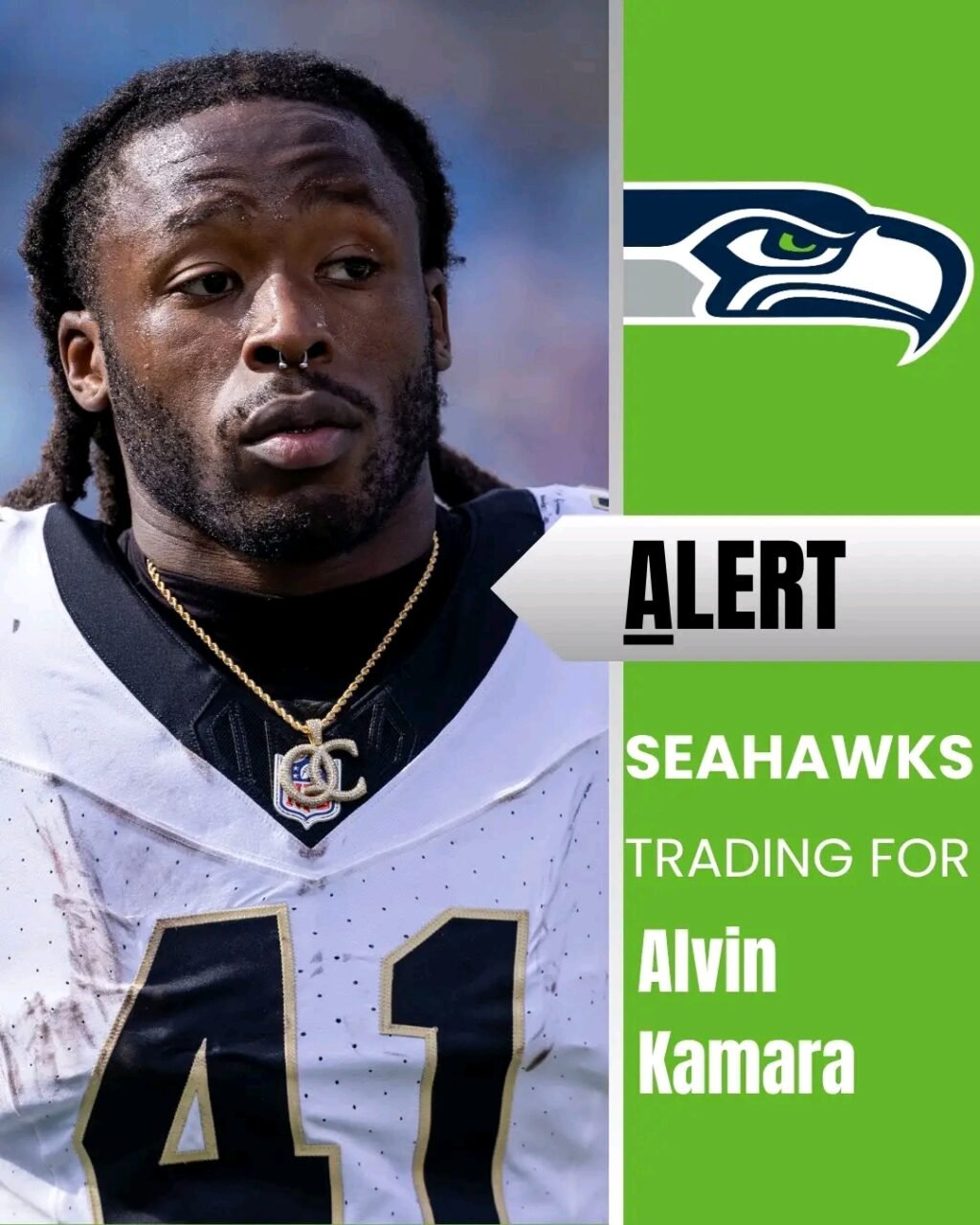
🚨 BREAKING: Seahawks Acquire Star RB Alvin Kamara in Trade With Saints, Due to Desperate Running Back Need After Losing Kenneth Walker and Zach Charbonnet’s Torn ACL
By NFL Nation Staff
April 23, 2026 – 8:47 PM ET
SEATTLE – The Seattle Seahawks have solved their running back crisis.
In a blockbuster trade announced just moments before the start of the 2026 NFL Draft, the Seahawks have acquired eight-time 1,000-yard scrimmage back Alvin Kamara from the New Orleans Saints. League sources confirm the Seahawks are sending a Day 2 pick—believed to be a third-round selection—to New Orleans in exchange for the veteran playmaker.
The move comes as Seattle faces one of the most precarious running back situations in the league, a crisis born from free agency departures, catastrophic injuries, and a draft class that offers no relief at the position.
Here is why the Seahawks had no choice but to make this bold, franchise-altering move.
—
Due to Losing Kenneth Walker in Free Agency
The Seahawks’ running back nightmare began in March when Kenneth Walker III, the team’s explosive home-run hitter and unquestioned RB1, walked out the door in free agency.
Walker, who finally cracked the 1,000-yard rushing mark in 2025 after three seasons of tantalizing flashes, was the engine of Seattle’s ground game. His elite lateral agility and ability to turn broken plays into 50-yard touchdowns made him one of the most feared runners in the NFC.
But when free agency opened, the Seahawks and Walker could not come to terms on a long-term extension. Walker departed for greener pastures, leaving behind a gaping hole in the backfield that Seattle has been unable to fill.
The front office’s response? A free-agent signing spree that, frankly, has alarmed fans and analysts alike. Seattle brought in Emanuel Wilson, a career backup who has never carried a full workload, and George Holani, an undrafted journeyman with just 31 career rushing yards.
Neither player inspires confidence as a Week 1 starter.
—
Due to Zach Charbonnet’s Torn ACL
Just when the Seahawks thought they could pivot to Zach Charbonnet—the powerful, north-south runner drafted in the second round to complement Walker’s speed—disaster struck.
Charbonnet, who had career highs in carries, rushing yards, and touchdowns during the 2025 season, suffered a torn ACL late last year. The injury was devastating not just for Charbonnet, but for the entire organization.
At 6-foot-1 and 214 pounds, Charbonnet was the perfect “thunder” to Walker’s “lightning”. He excelled in short-yardage situations, was a reliable pass protector, and had become a safety valve in the passing game. The Seahawks had every reason to believe he could step into the lead role if Walker left.
But a torn ACL requires a recovery timeline of 9 to 12 months. As training camp approaches, it remains unclear whether Charbonnet will be ready for Week 1—or if he will ever return to his pre-injury form.
That uncertainty left Seattle with an unthinkable depth chart: George Holani as RB1, Emanuel Wilson as RB2, and a collection of practice squad bodies behind them. For a team with playoff aspirations, this was simply unacceptable.
—
Due to a Historically Weak 2026 Draft Class at Running Back
Desperate teams often turn to the draft to find answers. But the 2026 NFL Draft offers the Seahawks no comfort.
As NFL Network’s Daniel Jeremiah has been warning for weeks, this year’s running back pool is “incredibly shallow”. While the draft is deep at edge rusher, wide receiver, and offensive line, the cupboard is nearly bare at running back.
“This draft is deep at Edge, WR & OL. However, this RB pool is incredibly shallow,” Jeremiah posted on social media this week.
That assessment has been echoed by every major draft analyst. There is no generational talent in this class. There may not even be a Week 1 starter available after the second round. For a Seahawks team that picks at No. 18 overall, reaching for a running back would be a panic move—and potentially a franchise-crippling one.
With no reliable rookie answer available, the trade market became Seattle’s only lifeline.
—
Due to Kamara’s Unique Availability and Contract Structure
Enter Alvin Kamara—a player who, just weeks ago, seemed untouchable in New Orleans.
Kamara signed a two-year, $24.5 million contract extension with the Saints earlier this April, a deal that runs through the 2026 season. At the time, it appeared the Saints were locking up their franchise icon for the long haul. Kamara has eclipsed 1,000 yards from scrimmage in all eight of his NFL seasons and is New Orleans’ all-time leader in touchdowns.
But behind the scenes, the Saints were quietly building an escape hatch.
First, New Orleans signed former Jaguar Travis Etienne to a four-year, $48 million contract in free agency. That move immediately crowded the backfield and raised questions about Kamara’s role. When head coach Kellen Moore was asked whether Kamara remained in the team’s plans, his answers were conspicuously noncommittal.
“He’s certainly on the roster and part of the running back room,” Moore said last month. That tepid endorsement spoke volumes.
Then came the contract restructure. The Saints used a little-known clause in the NFL’s collective bargaining agreement—the “50 percent rule”—to restructure Kamara’s deal in a way that lowered his 2026 cap number from $18.63 million to just $10.51 million. Crucially, the restructure did not add any guaranteed money beyond the $3 million Kamara was already set to receive this year.
In plain English: The Saints made Kamara extremely tradeable. If New Orleans moved him, they would face minimal dead cap consequences. The financial flexibility was baked into the deal.
—
Due to Kamara’s Willingness to Waive His Retirement Threat
The final piece of the puzzle—and perhaps the most dramatic—involves Kamara’s own stated intentions.
For years, the five-time Pro Bowl back has insisted he would rather retire than play for any team other than the Saints.
“I just got to keep my head down. And I don’t know, if I was a GM, I guess I would go to the player and be like, ‘Hey, we’re trading you. Just so you know.’ So, if Mickey Loomis comes downstairs and says that, then I’m going to go drink a piña colada somewhere,” Kamara famously said when asked about a potential trade last year.
That threat loomed over any trade discussions. Would Kamara actually retire rather than report to Seattle?
Sources close to the situation indicate that Kamara has since softened that stance. The opportunity to join a Seahawks team that just won the NFC West—combined with the Saints’ clear signal that they are moving forward with Etienne as their lead back—convinced Kamara to waive his no-retirement pledge.
A reunion with former Saints coach Sean Payton in Denver was also reportedly on the table, but Seattle’s aggressive offer won the day.
—
What This Means for Both Teams
For the Seahawks: This is a win-now move. Seattle is betting that Kamara, even at age 31 and coming off a career-low 471 rushing yards in 2025, has enough left in the tank to anchor their backfield. The Seahawks are also betting that Charbonnet will return from his torn ACL and form a formidable one-two punch with Kamara by midseason.
But there are red flags. Kamara has finished the past two seasons unable to play due to injuries. His production has declined. And the Seahawks gave up valuable draft capital for a running back on the wrong side of 30.
For the Saints: This trade signals a full embrace of the Travis Etienne era. New Orleans clears $18 million in cap space and adds a Day 2 pick in a draft where they need to get younger and cheaper. It also marks the end of an era: Kamara departs as arguably the most dynamic offensive weapon in Saints history.
—
The Bottom Line
The Seahawks acquired Alvin Kamara because they had no other choice. They lost Walker. Charbonnet is recovering from a torn ACL. The draft offers no answers. And the Saints, thanks to a creatively structured contract, were willing to deal.
Whether this move pays off or backfires will be debated for years. But one thing is certain: the Seattle Seahawks just went all in.