From X-Factor to Lifeline: What WR Jordyn Tyson Brings to the Saints Offense
NEW ORLEANS — For a franchise that has spent nearly half a decade searching for an offensive identity, the arrival of Jordyn Tyson represents more than just a first-round draft pick. It represents a strategic recalibration.
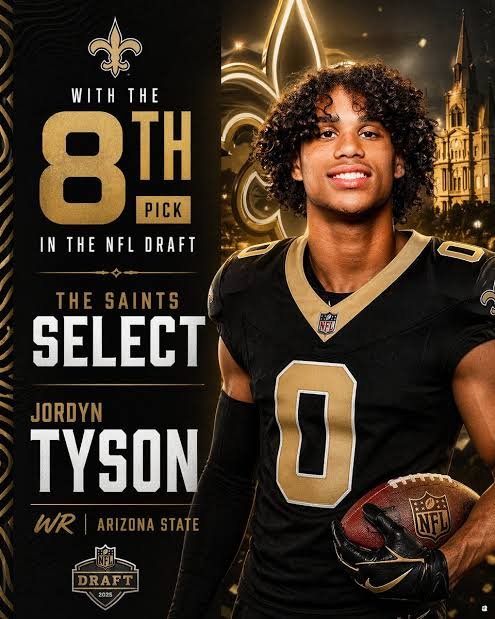
On Thursday night, the New Orleans Saints stayed put at the No. 8 overall pick and selected the Arizona State wide receiver, ending months of speculation about the future of their skill positions. While pundits debated the selection of a receiver with a complicated medical history, the reality in the Saints’ facility on Airline Drive was one of palpable relief. For head coach Kellen Moore and quarterback Tyler Shough, the addition of Tyson transforms an offense that ranked near the bottom of the league in explosive plays into a unit with a legitimate two-headed monster at wideout.
While durability remains the lone variable in this equation, the scouting consensus is unanimous: When on the field, Jordyn Tyson is a top-10 talent capable of running the full route tree, winning in contested traffic, and—perhaps most critically for Moore’s scheme—blocking in the run game.
The Strategic Fit: Beyond the “WR2” Label
The immediate narrative out of New Orleans is that Tyson slides in as the WR2 opposite Chris Olave. That is a convenient label but a tactical understatement. The Saints’ offense in 2025 was a study in fragility. According to ESPN’s annual skill position rankings, New Orleans entered last season ranked 24th in the league, with analysts noting that while the top of the depth chart was effective, the group “folded” when injuries hit .
That criticism fell squarely on the front office. The trade of Rashid Shaheed to the eventual Super Bowl champion Seattle Seahawks left a void not just in depth, but in athletic archetype. Shaheed provided the vertical “take the top off” threat. While Olave is a polished separator, the Saints lacked a true alpha boundary receiver who could win 50-50 balls and punish smaller defensive backs.
At 6-foot-2 and 203 pounds, Tyson offers that physical presence, but his value lies in his versatility. Analysts note that Tyson is “effective from anywhere in the formation” . During his time at Arizona State, he lined up outside, in the slot, and even in motion sets designed to exploit mismatches against linebackers. For Moore, a coach known for his work with the run-pass option (RPO) and play-action passing trees in Dallas and Los Angeles, this versatility is a cheat code.
Tyson allows Moore to keep his offense out of predictable down-and-distance situations. You cannot play Cover 2 (two deep safeties) against the Saints anymore without leaving a linebacker on an island with Tyson, just as you cannot stack the box to stop the run without leaving Olave one-on-one on the back side.
The Route Running: “Elite” Savvy
If you ask defensive backs who faced the Sun Devils over the last two years, they will tell you that Tyson’s speed isn’t what scares them—it’s the brakes.
While Tyson projects to run a 4.5-second 40-yard dash, which is considered average for an NFL starter, his football speed is significantly faster because of his footwork. Scouting reports consistently highlight Tyson’s “sudden route cuts” and “tremendous disguise” as separating him from the rest of this loaded receiver class .
Tyson has a rare ability to tempo his routes. He will lull a cornerback to sleep with a slow stem before exploding out of a break, creating the kind of separation that quarterbacks like Shough dream about. One AFC scouting director described him as “a surgeon” in the intermediate area of the field.
This is a specific tonic for Shough’s development. Entering his second year, Shough needs a safety valve who can get open without needing a perfectly scripted play. Tyson’s ability to adjust his routes based on coverage leverage—man or zone—means he operates almost as an extension of the quarterback’s mind. His catch radius is enormous, turning low or off-target throws into gains rather than incompletions .
The Hines Ward Effect: Toughness and Blocking
To understand what the Saints are getting, one must understand who trained him. At Arizona State, Tyson was coached by Steelers legendary wide receiver Hines Ward. Ward was famous for two things: clutch catches and bone-jarring blocks.
That mentality has permeated Tyson’s game. In a league where wide receivers are often labeled divas for avoiding contact, Tyson is an outlier. He finished fifth in the FBS in “run-blocking snaps” in his final season, an obscure stat that speaks volumes about his competitiveness .
This is a critical development for the Saints’ offensive line and running game. Kellen Moore’s offense, inspired by the Shanahan-McVay tree, relies on wide receivers to crack-down on safeties and seal the edges for outside zone runs. For the last two years, New Orleans’ inability to get consistent blocks from the perimeter stymied running back Alvin Kamara’s ability to turn the corner.
Tyson is not just a willing blocker; he is an enthusiastic one. “He often blocked defensive backs into the parking lot,” one draft analyst noted, crediting Ward’s physical tutelage . This “blocking mentality” is precisely the culture Klint Kubiak began trying to instill in the wide receiver room two years ago, and Tyson makes that philosophy a reality on the right edge .
The Injury Calculus: Risk vs. Reward
No scouting report on Jordyn Tyson is complete without addressing the elephant in the room: his medical history. The Saints are betting that they are getting a steal at No. 8, but the NFL slid him slightly due to durability.
In 2022, Tyson suffered a devastating knee injury at Colorado, tearing his ACL, MCL, and PCL simultaneously—a rare trifecta that cost him nearly two full years of development . After transferring to Arizona State and reviving his career, he battled a fractured clavicle requiring surgery in 2024 and persistent hamstring issues during his final collegiate season .
The 2025 campaign showcased the double-edged sword. When healthy, he was unstoppable: 10 catches for 105 yards and a touchdown against Texas Tech, and eight catches for 126 yards and two scores versus TCU . But he also missed multiple games down the stretch, finishing the year with nagging issues that capped his output.
For the Saints’ medical staff, this is a challenge they have embraced. The thinking inside the building is that many of these injuries—specifically the soft tissue hamstring strains—were the result of compensating for the previous knee reconstruction. As he gets further removed from the ACL tear and into a professional strength and conditioning program, the hope is that his body stabilizes.
Immediate Impact: Remaking the Depth Chart
The selection of Tyson immediately redefines the Saints’ wide receiver depth chart. Following the trade of Shaheed, the room was dangerously thin. Chris Olave remains the undisputed WR1, coming off a career year where he snagged 100 receptions for 1,169 yards and nine touchdowns . He is the quiet technician.
Tyson, by contrast, is the emotional spark.
Behind them, the Saints now have a functional rotation. Devaughn Vele, acquired from the Broncos, projects as a solid WR3/possession guy, while Kevin Austin Jr. and former second-rounder Ja’Lynn Polk—who missed 2025 with an injury—provide lottery-ticket depth .
Tyson’s presence pushes everyone down the depth chart one slot, which is essential. The Saints learned the hard way last year that relying on Mason Tipton or practice squad elevations for significant snaps is a recipe for offensive paralysis. With Tyson, defensive coordinators can no longer bracket Olave with a safety and a corner; they must pick their poison.
Conclusion
The New Orleans Saints are not asking Jordyn Tyson to save the franchise. They are asking him to be the X-factor.
With Alvin Kamara still producing at a high level and Chris Olave operating as one of the smoothest route runners in the NFC, the Saints have the infrastructure of a playoff offense. What they lacked was the “dog”—the receiver who thrives in the yellow zone (the 10-to-20-yard line), who fights for the extra yard, and who strikes fear into the heart of a nickel cornerback.
If Tyson stays healthy, this draft pick will be looked back on as the moment the Saints caught up to the rest of the explosive NFC South. If he doesn’t, the “injury prone” label will haunt a front office that took a gamble on talent. But in a league defined by weapons, the Saints just acquired one of the most well-rounded ones in the 2026 class. New Orleans finally has its running mate.
—
By the Numbers: Jordyn Tyson
· Height/Weight: 6’2″, 203 lbs
· 2024 Stats: 75 rec, 1,101 yds, 10 TD (1st Team All-Big 12)
· 2025 Stats: 61 rec, 711 yds, 8 TD (injury-limited season)