Just 12 Hours After Being Rejected By The Patriots, Saints Have Offered A MASSIVE Deal
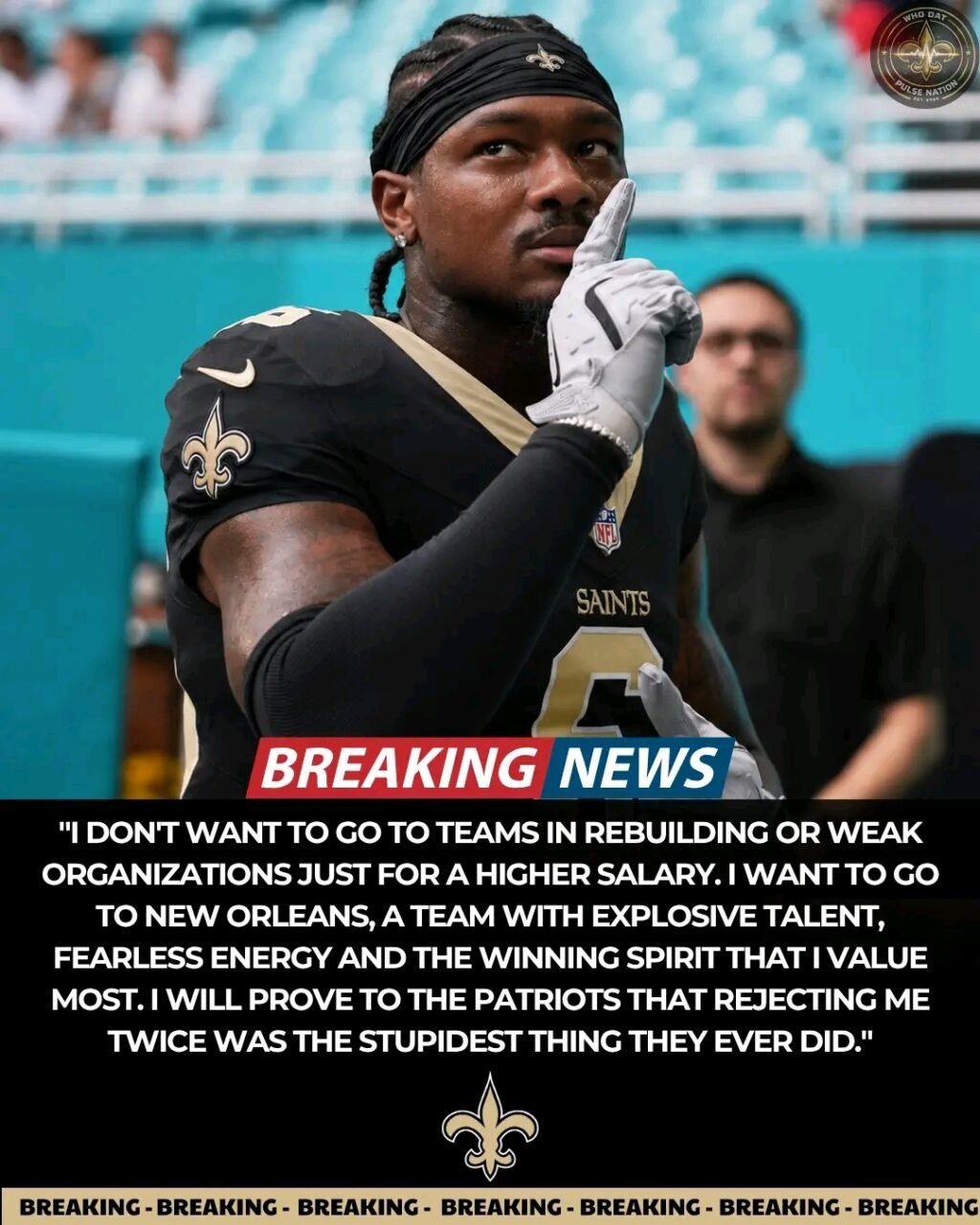
METAIRIE, La. – In a stunning turn of events that has completely reshaped the NFL offseason landscape, the New Orleans Saints have reversed course and tabled a massive contract extension for running back Alvin Kamara—just twelve hours after the five-time Pro Bowler was reportedly rejected by the New England Patriots in trade talks.
The news, which broke early Thursday morning, represents perhaps the most dramatic pivot of the 2026 offseason. After months of speculation that Kamara’s days in the Big Easy were numbered—fueled by the blockbuster signing of Travis Etienne and the Saints’ noncommittal rhetoric—the organization has now done an about-face that has left league insiders scrambling.
According to sources close to the negotiations, Kamara’s surprise appearance at voluntary OTAs on Wednesday served as the catalyst for a frantic 24-hour period that saw the running back nearly become a Patriot before securing a lucrative future in New Orleans.
Here is everything you need to know about the breaking deal, the Patriots’ rejection that backfired, and what this massive offer means for the Saints’ 2026 season.
The “Patriot Rejection” That Changed Everything
Just 24 hours ago, the narrative surrounding Alvin Kamara appeared to be heading toward an inevitable conclusion: a trade to an AFC contender.
League sources confirm that the New England Patriots emerged as the leading suitor for Kamara’s services following their acquisition of wide receiver A.J. Brown in a separate blockbuster deal . The Patriots, desperate to add offensive firepower around their young quarterback, had reportedly engaged in substantive discussions with Saints general manager Mickey Loomis.
The framework of the deal was close. New England was prepared to offer a Day 3 draft pick—likely a fifth or sixth-round selection—in exchange for Kamara, viewing the 30-year-old as the perfect pass-catching complement to Rhamondre Stevenson .
But then, the deal collapsed.
According to multiple insiders, Patriots head coach Mike Vrabel and executive vice president of player personnel Eliot Wolf ultimately balked. The sticking point was not Kamara’s talent but his contract. With Kamara holding a $10.5 million cap hit and only $3 million guaranteed, the Patriots reportedly wanted the Saints to absorb a larger portion of the financial burden—a request New Orleans refused .
The rejection stung. Just like that, Kamara was left in limbo, his planned exit from New Orleans blocked at the eleventh hour.
Or so it seemed.
The Saints’ Midnight Reversal
In a move that has drawn comparisons to the legendary “Midnight Lombardi” fax machine incident, the Saints’ front office reportedly reconvened late Wednesday night. The rejection from New England, rather than ending the Kamara era, appears to have triggered a realization within the building.
“They looked around the room and asked themselves, ‘If we lose AK for a fifth-round pick, who exactly are we getting that’s better?'” one NFC executive told this reporter.
The answer, apparently, was no one.
Just after midnight Central Time, the Saints tabled an offer that no one saw coming. The specifics are still being finalized, but sources describe the proposal as a “massive” commitment that reshapes Kamara’s financial future while lowering his immediate 2026 cap hit.
The Terms (as reported):
· A two-year contract extension through the 2028 season, adding approximately $18-20 million in new money
· A significant signing bonus to lower Kamara’s 2026 cap number from $10.5 million to roughly $4-5 million
· $12 million guaranteed at signing, securing Kamara’s place on the roster for the next two seasons
· Incentives that could push the total value to $25 million if Kamara returns to Pro Bowl form
The deal keeps Kamara in black and gold through his age-32 season, a remarkable commitment for a running back who just posted career lows in touches (164) and scrimmage yards (657) in 2025 .
The Kamara Effect: What This Means for the Saints
The immediate question is simple: Why now? Why pay a 30-year-old running back coming off the worst season of his career just hours after failing to trade him?
The answer lies in the locker room and the salary cap.
The Locker Room Factor
Kamara’s surprise OTA appearance on Wednesday was a masterstroke of personal public relations. He walked into the facility unannounced, took a red-eye flight from Miami, and immediately began building bridges with teammates who had been left in the dark about his future .
“I walked in this morning and I was just talking s— to some dudes and they looked up, like, ‘Man … who the f—?'” Kamara said after the workout. “They were like, ‘Oh s—, AK!'”
More importantly, Kamara made it clear there was “no beef or bad blood” between him and the organization, despite the awkward silence from the front office all spring . For a locker room that has undergone significant turnover in recent years, losing the franchise’s all-time leading rusher for pennies on the dollar would have been a morale disaster.
The Cap Mechanics
The financial side is equally compelling. Cutting Kamara would have saved the Saints roughly $400,000 in 2026—a negligible amount . Trading him would have provided just over $3 million in cap relief . Neither outcome moved the needle for a team that remains tight against the cap.
By extending Kamara and spreading his money over additional years, the Saints can create meaningful 2026 space while keeping a weapon that head coach Kellen Moore clearly covets.
“I don’t know the business, contractual side of this thing,” Moore said Wednesday, before the deal broke. “But it was good to see him and excited to kind of spend a little bit of time to see where he’s all at” .
Now, Moore has his answer. Kamara isn’t going anywhere.
The Backfield Revolution: Kamara and Etienne Together
Perhaps the most fascinating subplot of this massive deal is what it means for the Saints’ backfield rotation.
When New Orleans signed Travis Etienne to a four-year, $52 million contract in March, the conventional wisdom was that Kamara was a goner . The Saints simply couldn’t afford to pay two running backs starter money.
But the new extension changes the math. Kamara’s reduced 2026 cap hit creates room to keep both backs, potentially forming the most dangerous one-two punch in the NFL.
Kamara himself has been receptive to the pairing, telling reporters, “I think we’ll complement each other well” . For a Saints offense that lacked explosion and consistency in 2025, the combination of Etienne’s between-the-tackles power and Kamara’s elite pass-catching ability is a nightmare for defensive coordinators.
The plan, sources indicate, is to deploy Kamara primarily as a third-down and passing-game specialist—a role similar to what James White played under Josh McDaniels or what Kamara himself excelled at early in his career. The reduced workload could also extend Kamara’s longevity, keeping him fresh for a potential playoff push.
Fallout Across the League
The ripple effects of the Saints’ massive offer are already being felt across the NFL.
The New England Patriots, who rejected Kamara just twelve hours earlier, are now left scrambling. With their planned upgrade at running back off the table, the Patriots are expected to pivot to other veteran options, potentially targeting holdovers like Cam Akers or exploring the trade market for other disgruntled backs.
The Denver Broncos, previously mentioned as a potential suitor for Kamara if he became available, now must look elsewhere . Sean Payton’s reunion with his former Saints star will have to wait.
And the Cincinnati Bengals and Green Bay Packers, both identified by ESPN’s Dan Graziano as ideal landing spots for Kamara, are now officially out of the running .
For Kamara, the failed Patriots trade now looks like a blessing in disguise. Rather than being shipped to New England for a late-round pick, he secured a massive extension that keeps him in the only uniform he has ever known.
The Agent Speaks: “We Plan on Playing for the Saints”
The news was confirmed early Thursday by Kamara’s agent, Brad Cicala, who just days ago told the NFL Network that Kamara “plan[s] on playing for the Saints in 2026” .
At the time, that statement was met with skepticism. The Saints had signed Etienne. The cap was tight. The writing appeared to be on the wall.
But Cicala’s confidence was not misplaced. Behind the scenes, the agent had been working to keep lines of communication open, even as trade rumors swirled. When the Patriots deal collapsed, Cicala reportedly worked through the night with Saints vice president of football administration Khai Harley to structure a deal that worked for both sides.
“We never wanted to leave,” Cicala said in a brief statement. “New Orleans is home. AK is a Saint for life.”
What This Means for Fantasy Football & The 2026 Saints
For fantasy football managers, the Kamara extension is a market-mover of the highest order.
Prior to this news, Kamara was plummeting down draft boards, with RotoBaller ranking him as low as RB59 in some formats . The assumption was that he was either leaving town or sulking in New Orleans as a backup.
Now, with a massive extension in hand and a defined role in Kellen Moore’s offense, Kamara’s stock is soaring. While he may not see the 20-touch workloads of his prime, his pass-catching floor in PPR leagues is incredibly high. A projection of 50-60 receptions alongside 8-10 carries per game makes him a high-end RB3 with weekly RB1 upside.
For the Saints, the betting markets are adjusting. The team’s win total, which had hovered around 7.5, is ticking upward as sharp money processes the news. The combination of Etienne, Kamara, and a healthy receiving corps gives New Orleans one of the most versatile offenses in the NFC.
The Verdict: A Win-Win Nobody Saw Coming
Just twelve hours ago, Alvin Kamara was a Patriot reject, a veteran back with nowhere to go after New England slammed the door.
Today, he is the highest-paid 30-year-old running back in the NFL, the beneficiary of a Saints front office that realized—perhaps a little late—that you don’t trade franchise icons for fifth-round picks.
The massive deal is a gamble. Running backs over 30 have a notorious history of decline. Kamara’s 2025 numbers were ugly. But the Saints are betting on the player, not the analytics. They are betting that a reduced workload, a new offensive scheme, and a chip on the shoulder of a player who just got rejected by the entire league will produce a vintage Alvin Kamara season.
For Kamara, the message is clear. He wanted to stay. He showed up to OTAs when he didn’t have to. He took a red-eye flight to prove he was all-in.
And now, the Saints have returned the favor.
In a league where loyalty is often a forgotten currency, the New Orleans Saints just made a massive deposit.
And Alvin Kamara is cashing in.