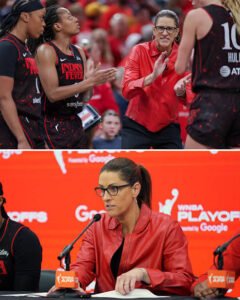
‘I Cannot Make a Decision to Not Recruit Somebody That Can Help Our Program’
BATON ROUGE, La. — In a bold move that reflects the complex intersection of sports and global politics, LSU women’s basketball coach Kim Mulkey has opened up about her decision to recruit Russian center Anna Minaeva to join a team that already includes Ukrainian forward Kate Koval. The pairing is believed to be the first of its kind in Division I women’s college basketball since Russia’s full-scale invasion of Ukraine began in 2022 .
The decision required a delicate conversation—one that took place not in a campus office, but in the parking lot of Koval’s apartment complex, with the car’s air conditioning running .
A Conversation in a Parking Lot
Mulkey knew she was navigating sensitive territory. Koval, a junior from Kyiv, has been open about the toll the war has taken on her family. Her father, Oleksandr, is a drone operator fighting on the front lines, and Koval has spoken about worrying for his life “every single day” . The Ukrainian president has reported more than 50,000 service member deaths, and civilian casualties have risen every month in 2026 .
When LSU assistant coach Fitzroy Anthony brought Minaeva’s film to the staff, Mulkey and associate head coach Bob Starkey recognized the 6-foot-5 center’s potential immediately. “Bob was like, ‘Wow, this kid’s special,’” Anthony recalled . But the coach knew she could not proceed without speaking to Koval first.
“I want you to understand I’m not here to ask you to change how you feel about Russia,” Mulkey told Koval, recounting the conversation. “I’m just here out of respect for your family and out of respect for you to let you know. Because I know how personal it is for you” .
The message was clear: Mulkey was not seeking permission, but she wanted to ensure Koval heard the news directly and with compassion.
“I love Kate. I love her family, and I wanted them to know. I wanted her to know,” Mulkey said. “You want her to feel your compassion, and yet you don’t ask her to change her feelings. Her feelings are what they are. You just want her to know and be informed. That’s all” .
The Basketball Case for Minaeva
From a purely basketball standpoint, the addition of Minaeva is a significant coup for the Tigers. At just 17 years old—she will not turn 18 until January—Minaeva already has professional experience playing for MBA Moscow in Russia’s Premier Basketball League .
Her statistics are impressive. In the Russian Superleague, playing for MBA Moscow-2, she averaged 15.1 points and 13.7 rebounds per game while shooting 50.8% from the floor. She also contributed 2.1 assists, 1.3 blocks, and 1.3 steals in 17 games . In the Premier League with the senior squad, she averaged 5.6 points and 4.0 rebounds in limited minutes .
“She has the experience, skillset and size to make an immediate impact in our frontcourt,” Mulkey said in a statement announcing the signing .
Minaeva is described as a polished post player with a soft touch, impressive vision, and the mobility to run the floor effectively. Her length allows her to block shots, and she is disciplined defensively. Some on the LSU staff believe she has the potential to become a WNBA draft pick .
A Unique Dynamic
The pairing of Koval and Minaeva creates a unique locker room dynamic. Both players represented their countries in international competition this past summer—Koval for Ukraine in the FIBA 3×3 World Cup, and Minaeva for Russia in the Russia-China youth games, where she was named MVP .
But the political reality of their homelands is impossible to ignore. Koval’s father continues to fight in a war that has killed thousands. Minaeva, who is still a teenager, has not spoken publicly about the conflict .
Mulkey’s rationale for the decision is rooted in her philosophy as a coach.
“Know that what I have to do in this business, I cannot make a decision to not recruit somebody that can help our program because of a conflict between two countries,” Mulkey said .
Context and History
This is not the first time Mulkey has shown sensitivity to Koval’s Ukrainian identity. In October 2025, after Koval transferred from Notre Dame, the coach renamed a team drill—formerly known as the “Russian Rebounding Drill”—to the “Ukraine Rebounding Drill” at Koval’s request . The drill, a grueling conditioning and rebounding exercise, had been a staple of Mulkey’s practices for over 40 years .
“Ukraine > Russia,” was the sentiment shared at the time .
The Minaeva signing, however, represents a different kind of challenge—one that goes beyond a drill name and into the fabric of the team itself.
Building a Roster
Minaeva is one of two international additions for the Tigers this offseason, joining Spanish forward Noa Morro, who signed in April . They will bolster a frontcourt that already includes Koval, sophomore Grace Knox, and sophomore Meghan Yarnevich .
LSU needed reinforcements. The program had to replace seven players from last season, including star senior Flau’jae Johnson, with six of those losses coming in the backcourt . The addition of Minaeva and Morro helps address size and depth concerns as the Tigers prepare for the 2026-27 season, which tips off Nov. 2 .
The Bigger Picture
The issue of Russian and Ukrainian athletes competing alongside one another has surfaced across the sports world. In June, a Ukrainian gymnast protested at a medal ceremony when Russian athletes were allowed to compete under their country’s flag. At the French Open, Ukrainian player Marta Kostyuk dedicated a victory to her country and criticized Russian opponents who had not spoken publicly about the war .
LSU’s situation is different. These are teenagers sharing a locker room, not competitors on opposite sides of a net. But the symbolism is undeniable.
Mulkey’s approach has drawn attention for its directness. She did not shy away from the difficulty of the decision, nor did she pretend that the war does not matter. She simply made her choice and communicated it clearly.
“I’m not here to ask you to change how you feel about Russia,” she told Koval. “I’m just here out of respect for your family and out of respect for you to let you know” .
As the season approaches, all eyes will be on Baton Rouge to see how this experiment unfolds—whether basketball can, at least within the confines of the court, transcend the conflict that has divided their homelands.