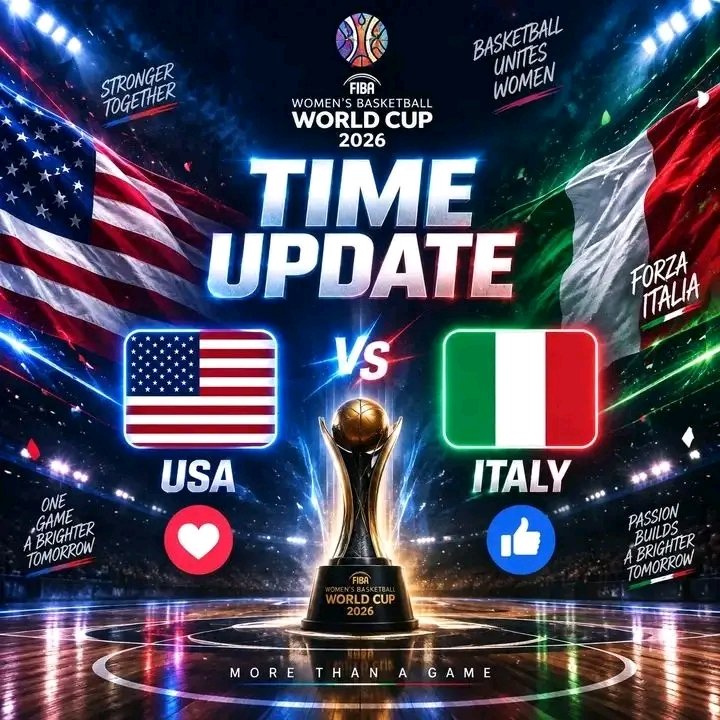
BERLIN — In a development that has sent ripples through the basketball world, FIBA has confirmed a sudden schedule adjustment for the blockbuster Group D showdown between the United States and Italy at the 2026 FIBA Women’s Basketball World Cup.
The game, originally slated for a primetime slot, has been moved up on the calendar, catching fans and analysts off guard as the tournament gets into full swing in the German capital . The announcement comes just hours after the U.S. opened its title defense with a dominant victory over China, setting the stage for a high-stakes clash that now carries even more weight in the race for group supremacy.
Schedule Shift Shakes Up Group D
According to the updated official schedule, the USA vs. Italy game will now tip off on Sunday, September 6, at 2:45 p.m. ET . While the date remains consistent with the original group play window, internal FIBA sources suggest the change was made to accommodate global broadcast demands and to balance the competitive equity of the Group D slate, which also features China and Czechia .
This adjustment means Team USA, led by head coach Kara Lawson, will face a quick turnaround. The Americans delivered a masterclass on Friday, dismantling China 94-61 in front of a sold-out crowd at the Max-Schmeling-Halle . Now, they must refocus for an Italy squad that is riding high after its own opening-day win against Czechia . The winner of this contest will likely secure the top seed in the group, granting direct passage to the quarterfinals and avoiding the perilous qualification round .
Clark’s Debut Sparks Buzz, Sets Up Italian Test
The excitement surrounding the rescheduled USA-Italy game is amplified by the global spotlight on Caitlin Clark. The Indiana Fever superstar, making her senior World Cup debut, was sensational against China, leading the team with 14 points and dishing out 11 assists—the highest single-game assist total for a U.S. player since Dawn Staley’s 12 in 1998 .
Clark’s performance, however, has become a lightning rod for controversy. Despite being named “Player of the Game,” FIBA’s official social media channels omitted Clark from their list of Day 1 top performers, naming instead Emma Meesseman, Sika Kone, Saki Hayashi, and two South Korean players . The snub has fueled frustration among U.S. fans, who argue the league is failing to capitalize on the momentum of a generational athlete.
Clark will look to translate that early momentum into a statement performance against an Italian defense expected to test the U.S. perimeter game. Her dynamic pick-and-roll chemistry with post players like Aliyah Boston and Napheesa Collier will be critical against an Italian squad known for its tactical discipline .
The Zhang Ziyu Factor Looming
While the immediate focus is on Italy, the “elephant in the room” remains China’s towering 7-foot-3 center, Zhang Ziyu. The 19-year-old phenom was the undeniable talking point of the tournament’s opening night, turning the game against the U.S. into a viral sensation .
Zhang scored 13 points and made 9 of 10 free throws, forcing the Americans to abandon their usual interior game plan . Players admitted post-game that playing against someone of her stature was unprecedented. “This was a different type of basketball game than I’ve probably ever played in my entire life,” Clark said after the win . “I’ve never played against a woman of that size.”
Despite the win, the U.S. coaching staff is aware that a potential rematch with China in the knockout rounds would present an even bigger challenge. The pressure is on to secure the top seed now; losing to Italy could potentially set up a semifinal showdown with the Chinese giant.
A Deeper Context: FIBA and Geopolitics
The excitement on the court is accompanied by a more somber off-court reality. While the rescheduling of the USA-Italy game appears logistical, FIBA is currently navigating choppy geopolitical waters regarding other World Cup fixtures. As previously reported, FIBA moved the Taiwan (Chinese Taipei) men’s team’s home game against China to a neutral venue in the Philippines, citing “the current geopolitical context” . This decision, which sparked protests from the Taiwan Basketball Association, underscores the complex international landscape FIBA must manage as it stages global events.
Looking Ahead: A Tight Turnaround
The sudden rescheduling means Team USA has little time to bask in its opening win. The clash with Italy on Sunday will be followed by a quick turnaround to face Czechia on Monday, with both games potentially determining the group’s final standings .
For Italy, the reschedule offers no tactical advantage but presents a massive opportunity. Already sitting on a victory against Czechia, a win against the heavily favored Americans would likely clinch the top spot and knock the defending champions off their pedestal.
For the U.S., the message is clear: the road to a fifth consecutive World Cup gold has just gotten a little bumpier, and the timetable has accelerated.