Michael Malone Unveils Three Pillars for UNC Basketball Revival
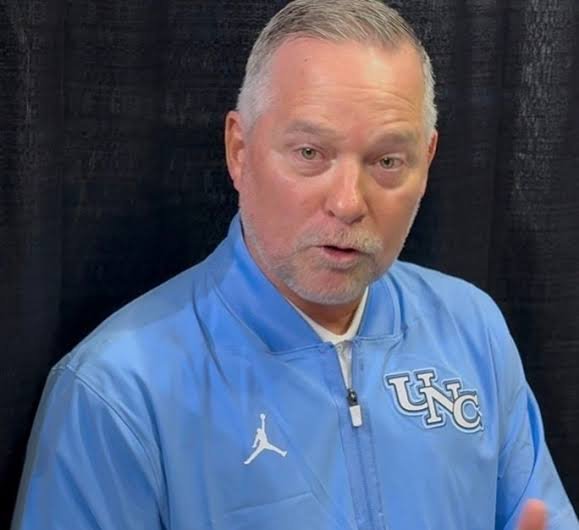
CHAPEL HILL, N.C. — The banners still hang in the Smith Center rafters, all 144 of them, a constant reminder of the standard at North Carolina. But for the first time in over 70 years, the man patrolling the sideline is an outsider. Michael Malone, the NBA championship coach tasked with reviving a blue blood, has spent his first months in Chapel Hill in what he describes as a state of controlled “chaos.” Now, with the roster set and the season approaching, Malone has revealed the three most important player developments he believes will define the Tar Heels’ 2026-27 campaign .
In a series of media appearances and press conferences, Malone laid out his vision. His strategy for a rapid rebuild is centered on three key developments: the complete overhaul of the backcourt, the expansion of Jarin Stevenson’s role, and the establishment of a culture rooted in effort and toughness .
The Transformed Backcourt
The first and most significant development for Malone was the complete reconstruction of the Tar Heels’ backcourt. When Malone took the job, the roster was in flux. He walked into a “portal room” filled with names of players he didn’t know, a whirlwind experience that he admits was overwhelming . However, he and his staff acted quickly to address what was a clear weakness.
“We addressed the backcourt,” Malone stated. “We added Terrence Brown, we added Matt Able, we added Neo Avdalas, and I think those three guys combine for one of the more dynamic and exciting backcourts in all of college basketball” .
The trio represents a significant financial investment, with reports indicating the Tar Heels’ roster spending exceeds $20 million—a figure that places them among the ACC’s top spenders . Brown, a transfer from Utah who averaged 19.9 points per game, brings scoring punch. Avdalas, a 6-foot-9 guard from Virginia Tech via Greece, offers unique size and playmaking, averaging 12.1 points and 4.6 assists last season . Able, a transfer from N.C. State, provides shooting and stability .
Malone believes this group solves a major problem for UNC. “Those guys have all been working very, very hard, and I think our backcourt has size, versatility, and we can go in a lot of different ways with how we use that backcourt,” he explained . This is a stark contrast to last season, where the Tar Heels were held back by an inconsistent backcourt. The new lineup is designed to be interchangeable, allowing multiple players to initiate the offense and play off the ball .
The challenge, however, is real. Brown and Avdalas both shot 33% or less from beyond the arc last season, and Brown’s shooting efficiency has been a point of concern for analysts . Yet, Malone’s confidence remains unshaken. He sees a unit that can apply relentless pressure on opponents and make UNC a dangerous team .
Unleashing Jarin Stevenson
The second key development is the evolution of forward Jarin Stevenson. As one of the few returning players—alongside Jaydon Young and Isaiah Denis—Stevenson is poised for a breakout season . Malone sees a player with untapped potential and has challenged him to expand his game.
“Jarin was a three, a four and a five,” Malone said, highlighting Stevenson’s versatility as his “superpower” . Malone has drawn a specific comparison for Stevenson’s role: Aaron Gordon of his former Denver Nuggets. This suggests Stevenson will be utilized in a variety of ways, from operating on the perimeter to playing as a small-ball center .
Malone also challenged the quiet Stevenson to make his presence known. “My challenge to Jarin when I got the job was: you might be quiet off the court, but on the court, I need you to be loud. Let your game be loud” . The coaching staff has been impressed with the results. “It’s always neat for me to listen to the coaches that have been here and for them to tell me that Jarin is doing things they haven’t seen him do,” Malone added .
Defensively, Stevenson’s ability to switch on multiple positions provides Malone with critical lineup flexibility. With the center position still a question mark due to the addition of international prospects like Sayon Keita and Alexandros Samodurov, Stevenson’s ability to play the five in certain situations is invaluable . His development is a cornerstone of the new-look Tar Heels.
Establishing a New Culture
The third and arguably most foundational development is the cultural shift Malone is implementing. He is building UNC’s identity around the same principles that guided him to an NBA championship in Denver: defense, rebounding, and relentless effort .
“I am a defensive-minded coach. I believe defense wins championships,” Malone said . This philosophy is being drilled into a roster featuring 11 new players. Malone has emphasized that the style of play is non-negotiable, regardless of the results on the scoreboard.
“I want our guys to buy into our style of play and our identity and how we want to play. Regardless of the result, I want our fans to walk out of the Dean Smith Center every night and say, you know what, they played hard, they played with toughness, they played together,” he stated .
This message is about more than just tactics; it’s about rebuilding a culture of selflessness and accountability. Malone has been clear about his expectations: “If you have a motor, you’re tough and you have an IQ, you have a chance to be a hell of a player,” he said . He added, “Get over yourself. Check your ego at the door” .
This philosophy includes a renewed focus on an area that has historically been a pillar of the program: rebounding. “I want to be a team that defends, rebounds at a high level and gets out and runs and plays at a fast pace, up-tempo basketball, and attacks before they get set,” Malone explained .
While the talent and price tag of the roster are high—ranked as the 44th-best in the country by some projections —Malone knows that talent alone isn’t enough. The success of the 2026-27 Tar Heels will depend on how quickly the new pieces gel and whether they adopt the toughness he demands. The pressure is immense, but Malone is embracing it.
“I didn’t come here to be second best. I didn’t come here to lose in the first round of the ACC tournament. I came here to win and win at a big level, win at a high level,” he declared .
The days of “chaos” are giving way to a new, defined identity. If his three key developments take hold, the Tar Heels may just be on their way back to the top of college basketball.