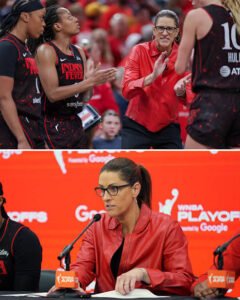
Why Caitlin Clark, Angel Reese Aren’t Starting for Team USA at FIBA World Cup
Berlin — As Team USA prepares for its quarterfinal showdown against Hungary at the 2026 FIBA Women’s Basketball World Cup, one question continues to dominate conversations among basketball fans worldwide: Why aren’t Caitlin Clark, Angel Reese, and Paige Bueckers in the starting lineup?
The answer, according to head coach Kara Lawson, is simpler than the controversy suggests.
Lawson Stands Firm on Veteran Lineup
Despite mounting pressure from fans and analysts, Lawson has made her position abundantly clear. When asked directly whether she would consider moving Clark into the starting five for Thursday’s knockout game, the coach offered a measured response.
“I think that our starting group’s done a pretty good job of getting us off to good starts,” Lawson said. “Rotationally from game to game we could change things, but I like where we are right now.”
That same answer was repeated when Lawson was asked about Bueckers and Reese potentially earning starting roles. The message was unmistakable: the coaching staff is prioritizing continuity over star power.
Team USA has opened the tournament with an unblemished 3-0 record in group play, defeating China (94-61), Italy (55-52), and Czechia (105-64). Lawson has relied on a veteran-heavy starting five featuring Chelsea Gray, Jackie Young, Kahleah Copper, Napheesa Collier, and Breanna Stewart—a group with extensive Olympic and World Cup experience.
Clark’s Historic Production Off the Bench
While Clark may not be starting, she has hardly been sidelined. The Indiana Fever superstar leads Team USA with 6.3 assists per game and is averaging 21.9 minutes per contest—the highest on the team.
Her tournament debut against China was nothing short of spectacular. Clark recorded 14 points and 11 assists without committing a single turnover, marking the most assists by an American in a World Cup game since Dawn Staley dished out 12 in 1998.
According to FIBA’s official statistics, Clark ranks third among all players in the tournament in assists per game. She is also the only American player to appear in the top five of any major statistical category.
“Caitlin was terrific coming off the bench,” Lawson said after the China game. “She changed the tempo of the game.”
That acknowledgment has only fueled questions about why Clark isn’t dictating that tempo from the opening tip.
Reese and Bueckers Also Making Impact
Angel Reese has been equally productive in her reserve role. The Atlanta Dream forward is averaging 8.7 points and 6.0 rebounds per game, ranking third on the team in rebounding. Through three games, she has posted 26 points, 18 rebounds, four steals, and three blocks while shooting 57.1% from the field.
Paige Bueckers has been remarkably efficient when called upon. The Dallas Wings guard is shooting 59.1% from the field and averaging 10.3 points per game, while also leading the team with 1.3 blocks per contest.
The arrangement has allowed Lawson to deploy her bench as a strategic weapon. Clark, Bueckers, and Reese provide production after entering games, giving the coaching staff flexibility against different opponents and game situations.
The Debate Over Experience vs. Production
Not everyone is convinced by Lawson’s reasoning. Hall of Fame sportscaster Linda Cohn has been among the most vocal critics.
“I still don’t understand why Chelsea Gray is starting at point guard over Caitlin Clark,” Cohn said on her podcast. “This isn’t about disrespecting Chelsea Gray. She’s a two-time Olympic gold medalist, a champion, one of the most experienced players on this roster. But aren’t we trying to win the World Cup?”
Cohn pointed to the statistical disparity between the two guards. Clark is averaging 8.0 points and 6.3 assists, while Gray has struggled to find her rhythm, averaging just 3.6 points and 1.0 assist per game.
The concern was amplified after Team USA’s narrow 55-52 victory over Italy—the team’s lowest-scoring World Cup performance since 1971. The four returning starters from the Paris Olympics combined to shoot just 5-of-23 in that game.
Global Popularity vs. Playing Time
The controversy has extended beyond basketball strategy. FIBA’s official website revealed that Clark is the most-visited American player at the tournament, ranking third globally in player page views behind only China’s Zhang Ziyu and Han Xu.
Yet despite being the primary draw for international audiences in Berlin, Clark remains in a reserve role. Fans on social media have expressed frustration, with some accusing USA Basketball leadership of mismanaging its biggest star.
“Team USA sabotaging themselves is bananas,” one user wrote on X. “Every international coach should be sending thank you notes to Coach Lawson.”
Another fan added: “The way CC is mistreated by the WNBA players and coaches is very sad.”
What’s Next for Team USA
Lawson’s approach echoes her handling of Clark during World Cup qualifying earlier this year, when the Fever guard earned tournament MVP honors while averaging 11.6 points and a tournament-best 6.4 assists across five games—mostly coming off the bench.
The strategy has produced results so far, with Team USA advancing to the quarterfinals unbeaten. But the margin for error shrinks considerably in knockout play.
France recently overtook Team USA for the No. 1 spot in FIBA’s official power rankings after the Americans’ offensive struggles against Italy. With elimination games ahead, the pressure on Lawson to adjust her rotation will only intensify.
Whether the coach’s commitment to her veteran starters ultimately proves wise or costly will be determined on the court. For now, Lawson remains unmoved.
“I like where we are right now,” she said.