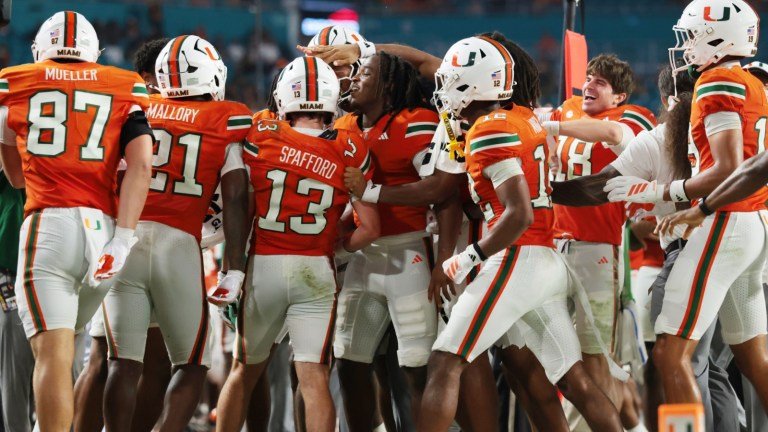
The University of Miami has agreed to a landmark 10-year apparel deal with Nike worth more than $200 million, marking a dramatic return to the Swoosh after an 11-year absence and ending its partnership with Adidas . The deal, first reported by the Miami Herald, is expected to take effect on July 1, 2027, and is being described as one of the most lucrative sponsorship agreements in college sports history .
According to multiple reports, the contract will pay Miami approximately $20 million annually, with roughly two-thirds of that value coming in direct cash payments and the remainder in apparel and marketing elements . This represents a massive upgrade from the Hurricanes’ current arrangement with Adidas, which reportedly paid the university around $6.5 million per year in cash over the life of a 12-year, $90 million deal signed in 2015 .
The move carries profound symbolic weight for Miami, a program whose football identity was forged in the 1980s and 1990s while wearing Nike. In 1987, Miami became the first university to sign an all-sports contract with Nike, a groundbreaking agreement that helped elevate both the Hurricanes and the fledgling apparel giant . That partnership lasted nearly three decades, spanning four national championships in football, before Miami stunned the sports world by leaving for Adidas in 2015 .
Why Miami Made the Switch
At the time of the original Adidas deal, Miami was in a different place. The football program was navigating a down cycle, and Adidas offered considerably more money than Nike was willing to pay while promising to make the Hurricanes a flagship property . That calculus has now reversed.
Under head coach Mario Cristobal, Miami has reemerged as a national contender. The Hurricanes reached the College Football Playoff championship game last season and entered 2026 with high expectations, boasting one of the nation’s most explosive offenses . The men’s basketball program has also flourished, reaching the Final Four in 2023 . With Miami’s brand value surging, Nike moved aggressively to bring the Hurricanes back into its portfolio.
The Miami Herald reported that Adidas had a contractual right to match Nike’s offer and presented a counterproposal, but did not fully match the terms . According to sources, there were creative provisions in the Nike contract that were difficult for Adidas to replicate . Adidas had also invested heavily in South Florida, signing a five-year, $13.5 million deal in 2025 to outfit all public schools in Miami-Dade County . That grassroots strategy, however, was not enough to retain the Hurricanes.
The Financial and Strategic Implications
The $20 million annual value places Miami’s deal among the elite apparel contracts in college athletics. It is expected to become Nike’s largest deal with a college program, surpassing its arrangement with Oregon . For context, Miami’s current Adidas deal paid roughly $7.5 million annually in total value when apparel is included; the Nike agreement nearly triples that figure .
Miami plans to direct the additional revenue toward several priorities: athletic department operating costs, Name, Image, and Likeness (NIL) allocation for student-athletes, and potentially an on-campus football office building that remains in early planning stages . In an era where NIL resources are increasingly decisive in recruiting, the cash infusion could provide a significant competitive advantage.
For Nike, the deal represents a strategic win after losing Tennessee and Penn State to Adidas in recent years . It also reshapes the apparel landscape in Florida, where Nike now holds a 4-3 advantage among the state’s seven FBS programs, with Miami joining Florida, Florida State, and UCF under the Swoosh umbrella .
What It Means for Adidas
Losing Miami is a substantial blow to Adidas, which had made the Hurricanes the centerpiece of its college sports strategy. Over the past decade, Miami served as Adidas’s flagship NCAA program, and the brand expanded its presence throughout South Florida at both the college and high school levels . The company’s partnership with Miami-Dade County Public Schools and individual NIL deals with Hurricanes athletes like wide receiver Malachi Toney underscored its commitment to the region .
For Adidas, the challenge now is recalibrating its college portfolio. The brand still maintains relationships with major programs including Tennessee, Penn State, Texas A&M, and Indiana, but the loss of Miami removes a marquee property in one of the nation’s most talent-rich recruiting regions .
The Emotional Homecoming
Beyond the dollars and strategy, the return to Nike resonates deeply with Miami’s alumni and fan base. The Hurricanes’ championship era—the swaggering teams of Jimmy Johnson, Dennis Erickson, and Butch Davis—is inseparable from the Nike brand. Four national titles were won with the Swoosh on Miami’s uniforms . Former Hurricanes fullback and current New England Patriots executive Alonzo Highsmith captured the sentiment on social media, posting simply, “We are back,” alongside an image of the Nike logo .
ESPN analyst Kirk Herbstreit, a frequent critic of Miami’s recent uniform designs under Adidas, celebrated the news as well. “Miami players too good to be wearing those baggy pants,” he wrote. “Great news for the Canes” .
The timing creates some short-term awkwardness. Miami is expected to wear throwback uniforms this season commemorating the 25th anniversary of its 2001 national championship team—a squad that wore Nike—while still under contract with Adidas . For one final year, the Three Stripes will outfit the Hurricanes, but the future is already orange and black, stitched with the Swoosh.
When July 2027 arrives, Miami will officially begin a new chapter with an old partner, armed with one of the richest apparel deals in college sports and a renewed sense of its own identity.