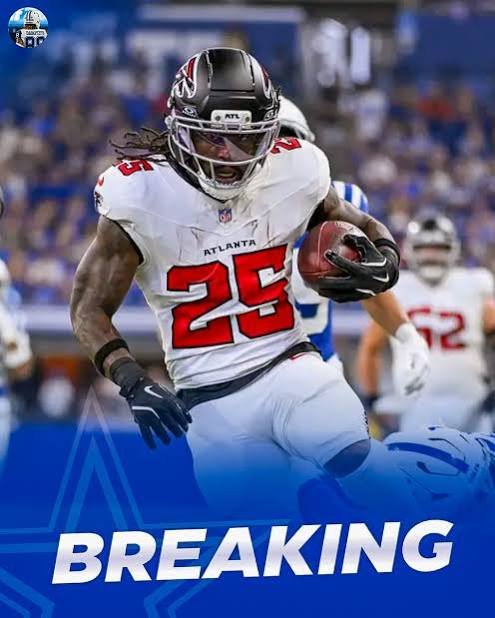
In the modern National Football League, building a championship-caliber roster is a continuous, 365-day operational challenge. Front offices must look beyond the marquee transactions of the spring—the multi-million-dollar free agency periods and the highly televised draft—to find vital depth. Instead, some of the most critical adjustments happen in the quiet margins of the regular season. This reality was vividly illustrated when the Dallas Cowboys poached 25-year-old running back Tyler Goodson from the Atlanta Falcons’ practice squad.
Faced with a sudden void in their offensive backfield after backup running back Malik Davis suffered a severe hip injury, the Cowboys did not look to the dwindling list of aging street free agents. Instead, they weaponized the NFL’s strict system of roster poaching. By exploiting specific league bylaws, Dallas extracted a young, scheme-ready asset directly from a conference rival, signing him directly to their active 53-man roster. This transaction highlights the complex roster mechanics, financial obligations, and tactical desperation that define front-office operations during the grueling regular season.
To fully appreciate the Cowboys’ acquisition of Tyler Goodson, one must first understand the strict legal framework established by the NFL and the NFL Players Association (NFLPA) regarding practice squads. The practice squad is not a separate entity; it is a developmental reservoir of players who practice with the main team but do not suit up for Sunday games unless temporarily elevated.
Crucially, players signed to an NFL practice squad are technically free agents regarding the rest of the league, with one major caveat: **they can only be signed by an opposing team if they are placed directly onto that team’s active 53-man roster.** A team cannot poach a player from another franchise’s practice squad simply to place them onto their own practice squad.
* **Player Protection:** It prevents wealthy or aggressive franchises from hoarding young talent on developmental units. It ensures that if another team values a practice squad player enough to sign them, that player receives an immediate promotion to the active roster, complete with a substantial pay increase to the active roster minimum salary.
* **Competitive Balance:** It rewards meticulous scouting departments. If an organization spends months identifying, tracking, and evaluating a player on another team’s developmental roster, they can bypass traditional trade negotiations and acquire that asset instantly, provided they have an open slot on their 53-man roster.
* **The Three-Week Roster Guarantee:** Under the collective bargaining agreement, any player poached from an opposing practice squad must remain on the acquiring team’s active 53-man roster for a minimum of three weeks. Even if the player is cut or waived before those three weeks expire, the team must still pay them their active roster salary for that entire three-week duration. This prevents teams from briefly poaching a player to extract tactical playbook secrets before dropping them back into free agency.
The decision to execute a practice squad raid is rarely a luxury; it is almost always born out of immediate positional distress. For the Dallas Cowboys, the catalyst was a significant blow to their running back depth in Week 1. When Malik Davis was placed on injured reserve with a hip injury, the Cowboys were left dangerously thin behind starting running back Javonte Williams and primary backup Emari Demercado.
In a modern NFL offense, a team cannot comfortably enter a game with only two healthy, active running backs. The position is simply too violent, and the physical wear and tear is too extreme. An unexpected in-game injury to Williams or Demercado would leave the Cowboys completely incapable of executing their balanced offensive attack.
Dallas targeted Tyler Goodson because he represented the ideal blend of youth, experience, and system compatibility. At 25 years old, Goodson is in his physical prime, possesses fresh legs, and has already logged meaningful regular-season snaps during a previous stint with the Indianapolis Colts.
Furthermore, Goodson’s scouting profile matches what Brian Schottenheimer’s offense requires from a depth piece. He is a highly capable pass-catcher out of the backfield, possessing the lateral agility to operate in space on third-down screen plays. Because NFL practice squads run simulated versions of opposing schemes every week, Goodson was already in peak physical condition and football shape. He did not require weeks of conditioning; he simply needed to learn the Cowboys’ specific terminology and protection calls.
From the Atlanta Falcons’ perspective, losing Tyler Goodson hurts, but it is an accepted risk of the practice squad system. Teams are permitted to protect up to four specific practice squad players each week from being poached by opposing franchises. However, these protections do not carry over indefinitely and must be designated by a specific weekly deadline.
If an opposing team makes a legitimate offer to a non-protected practice squad player, the original team does have a small window of opportunity: they can offer the player an active roster spot on their own 53-man squad to keep him from leaving. However, if the original team’s 53-man roster is already completely full, or if they do not view the player as an immediate priority for their active lineup, they must stand aside and let the player walk.
For Atlanta, their roster was locked, and they could not justify waiving a contributing special teams player or defensive depth piece just to block Dallas from taking an extra running back. As a result, Goodson packed his bags and flew to Texas, leaving the Falcons to scan the free-agent market to replace his spot on their practice squad.
Signing a player off a practice squad on a Tuesday means the coaching staff is facing a race against the clock to get him ready for Sunday’s game. Goodson arrived at the Cowboys’ facility, passed his mandatory physical, and was immediately handed a playbook.
His initial role will likely be tightly managed. In his first few games, Goodson will operate strictly as the RB3, providing emergency depth behind Williams and Demercado. Coaches will focus heavily on ensuring he understands the team’s pass-protection assignments. In the NFL, a backup running back’s quickest path to the bench—or to getting cut—is failing to pick up a blitzing linebacker, which can lead to a devastating hit on the franchise quarterback.
As he builds comfort with the playbook, Goodson’s role could expand. His explosive burst makes him a viable option for change-of-pace carries, keeping defenses off-balance when Javonte Williams needs a breather.
The acquisition of Tyler Goodson is a perfect case study in efficient, proactive NFL front-office management. By understanding league rules and moving aggressively to pluck a talented player from the Atlanta Falcons’ practice squad, the Dallas Cowboys successfully solved an immediate depth crisis without sacrificing future draft capital in a trade.
While the headline stories will always focus on superstars like Dak Prescott and CeeDee Lamb, the ultimate success of the 2026 Dallas Cowboys season will depend heavily on the resilience of their depth. In Tyler Goodson, Dallas secured a motivated, talented asset who is eager to prove he belongs on an active 53-man roster permanently.
I can provide further updates on how Goodson performs in practice or detail the adjustments to the rest of the Cowboys’ active lineup. Would you like to check out:
* The **updated active running back depth chart**?
* The **scouting report** on Tyler Goodson’s rushing style?
* The **rules regarding how long Malik Davis must stay on injured reserve**?