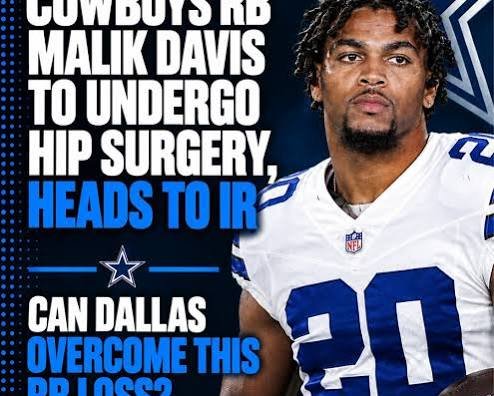
In the high-stakes world of the National Football League, a player’s season can alter course in a single, unscripted second. For Dallas Cowboys running back Malik Davis, the cruel nature of professional football was realized not under the bright lights of a nationally televised game, but in the quiet, focused environment of a Friday practice walk-through. On September 11, 2026, just 48 hours before the Cowboys were scheduled to kick off their regular season against the New York Giants, Davis suffered a severe hip injury that required him to be carted off the field.
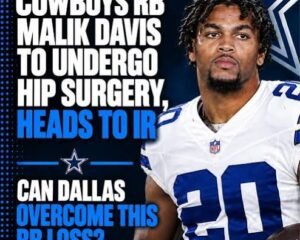
The subsequent medical evaluations delivered a devastating blow: Davis required immediate surgery, forcing the Cowboys to officially place him on Injured Reserve (IR) on Saturday, September 12, 2026. Because the front office did not designate him for a late-season return, the transaction effectively ended his 2026 campaign before it could even begin. This development reshuffled the Cowboys’ offensive backfield, altered their structural depth, and thrust the team into a position of tactical desperation heading into the early stretch of the season
While the Dallas Cowboys’ front office and medical staff kept the highly specific technical diagnosis of Davis’ hip injury confidential—adhering to standard NFL operational privacy—the timeline and the immediate surgical intervention point to a major structural failure. In high-impact sports like football, sudden hip injuries requiring immediate, season-ending surgery typically fall into a few severe categories: a posterior hip dislocation, an associated acetabular (socket) fracture, or a high-grade labral tear accompanied by structural bone damage.
The hip is a deeply recessed ball-and-socket joint surrounded by dense ligaments, a thick muscular sheath, and a protective cartilage ring known as the labrum. For a running back, the hips are the central engine of athletic performance; they generate the explosive downhill power, lateral cutting ability, and low center of gravity required to break tackles. When a structural injury occurs in this joint, the physical mechanics of running are completely compromised.
An injury of this magnitude usually occurs when a player experiences a violent axial load—such as falling awkwardly with all their weight driven through a flexed knee and hip, or suffering a sudden twisting subluxation while trying to plant and cut on the turf. The force violently drives the femoral head against the back of the socket. The resulting trauma causes immense pain, immediate loss of weight-bearing capability, and requires swift surgical stabilization to prevent long-term avascular necrosis (loss of blood supply to the bone).
When the Cowboys placed Malik Davis on Injured Reserve on September 12, they had to navigate the strict roster management rules set by the NFL. The modern IR system allows teams flexibility, but it carries strict parameters regarding timing and return designations.
Under league rules, teams are permitted to designate up to eight players to return from Injured Reserve over the course of a single season (with additional spots available if a team makes the postseason). However, for a player to be eligible for a return designation, they must fulfill specific criteria. Most importantly, a player *must* be included on the initial 53-man roster at the start of the regular season league year or carried past the final cutdown day before being placed on IR.
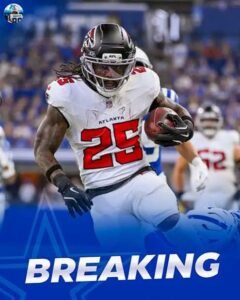
Because Davis’ injury occurred right on the eve of Week 1, Dallas had the mechanical right to place him on IR with a return designation after four weeks. However, the severity of his hip injury and the lengthy post-surgical rehabilitation timeline meant that a return in 2026 was medically impossible. By placing him on IR without a return designation, the Cowboys acknowledged that his recovery would stretch well into the 2027 offseason. This move permanently locked his roster spot for the year, allowing Dallas to completely free up a valuable space on their active 53-man roster to acquire outside help, which ultimately led to the poaching of Tyler Goodson.
Losing Malik Davis on the eve of the season opener created an immediate tactical vacuum within head coach Brian Schottenheimer’s offensive scheme. Entering training camp, the Cowboys had constructed a running back committee designed to complement starting running back Javonte Williams. Davis was heavily projected to serve as a vital change-of-pace back and a reliable pass-protection asset on third downs.
Davis possesses a unique running style characterized by short-area quickness, decisive vision, and excellent hands out of the backfield. His ability to act as a safety valve for quarterback Dak Prescott in the screen game and intermediate checkdowns was supposed to be a focal point for neutralizing aggressive defensive coverages. Furthermore, Davis had spent significant time mastering the team’s complex blitz-pickup schemes—a critical duty for any backup running back tasked with keeping a franchise quarterback clean.
When Davis went down, the burden immediately shifted to Emari Demercado to absorb all backup duties, which exposed the team’s lack of proven depth during their 28-20 loss to the New York Giants. The running game looked stagnant, and the lack of a true multi-back rotation allowed the Giants’ defensive front to pin their ears back and pressure Prescott. The absolute necessity of having three capable running backs on a weekly active roster forced the front office to scan the league’s practice squads, resulting in the rapid signing of Tyler Goodson from Atlanta just days later.
For Malik Davis, the journey ahead is no longer measured in yards per carry or touchdowns, but in physical therapy milestones and range-of-motion percentages. Recovering from major hip surgery is a grueling, multi-month process that requires patience and meticulous care to ensure the joint stabilizes correctly.
The first phase of his rehabilitation will focus entirely on immobilization and protecting the surgical repair, keeping weight off the joint to allow the bone and repaired ligaments to heal. As the weeks progress into the late fall, Davis will transition into passive and active range-of-motion exercises to prevent the hip capsule from freezing or building up restrictive scar tissue. Only after the joint has completely healed structurally can he begin the arduous process of rebuilding the atrophied musculature—specifically the gluteal complexes, hip flexors, and core stabilizers.
Because the injury occurred in September, Davis has the luxury of a full calendar year to rehabilitate before the 2027 NFL training camp cycle begins. While the physical road is daunting, modern sports medicine has vastly improved the recovery rates for major hip procedures, giving the 27-year-old running back a realistic path toward a full athletic recovery.
The season-ending injury to Malik Davis serves as a stark, sobering reminder of how quickly an NFL team’s meticulously laid plans can be disrupted. A routine Friday walk-through turned into a franchise-altering moment for the Cowboys’ backfield depth. While Davis begins his long journey back to health on the injured reserve list, his absence will continue to shape how the Dallas offense evolves over the course of the 2026 season. The success of the team’s ground game now rests on how quickly new pieces like Tyler Goodson can integrate, forcing the Cowboys to display ultimate resilience in the face of early-season adversity.