Manchester United co-owner Sir Jim Ratcliffe has come under intense criticism after saying the UK has been “colonised by immigrants,” remarks that have sparked a political and cultural backlash far beyond football.
The comments were made during a media interview in which Ratcliffe was discussing immigration levels and their perceived impact on the country.
Using the phrase “colonised by immigrants,” he argued that rapid population change has placed pressure on public services and altered communities across Britain. The language he chose, however, immediately drew strong reactions from politicians, supporters’ groups and anti-racism organisations, many of whom described the wording as inflammatory and divisive.
Senior political figures were quick to condemn the remarks, saying the characterisation of immigration as “colonisation” was inappropriate and did not reflect the values of a diverse modern Britain. Critics argued that such language risks fuelling division at a time when immigration is already a sensitive and polarising topic in national debate. Some called on Ratcliffe to apologise or clarify his comments, stressing that public figures associated with globally recognised institutions should be mindful of their words.
The backlash has been particularly pronounced within the football community. Manchester United is one of the most internationally supported clubs in the world, with a squad, staff and fanbase drawn from a wide range of backgrounds and nationalities.
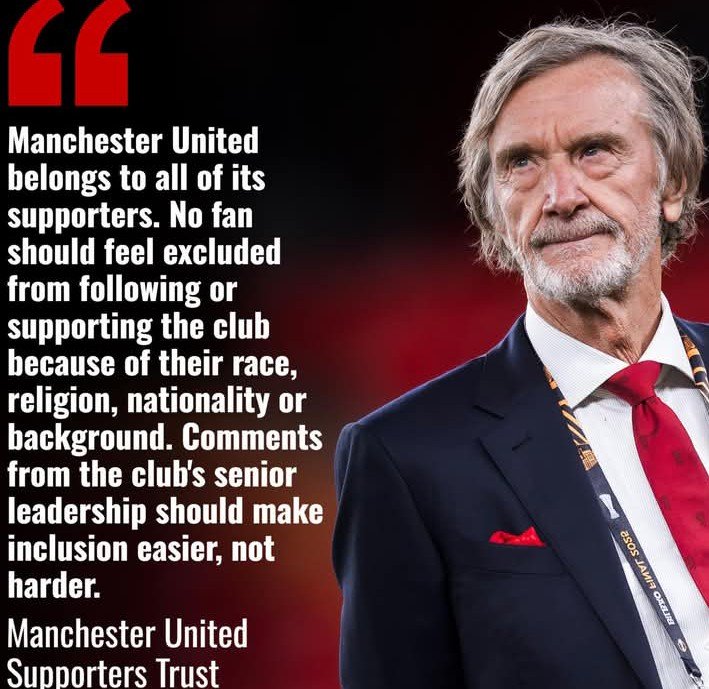
Supporters’ groups have voiced concern that the remarks sit uneasily with the inclusive image the club promotes. Several fan organisations released statements distancing themselves from the comments and reiterating their commitment to equality and diversity within the sport.
Anti-discrimination bodies connected to football also criticised the phrasing, noting that terms such as “colonised” can carry historical and political weight. They argued that football has worked hard in recent decades to combat racism and promote inclusion, and that rhetoric perceived as hostile toward immigrant communities risks undermining that progress.
Ratcliffe, one of Britain’s wealthiest businessmen and the founder of chemicals giant Ineos, acquired a minority stake in Manchester United as part of a deal that gave him significant control over football operations. Since then, he has been a prominent and sometimes outspoken figure in discussions about the club’s direction, finances and long-term strategy.
This latest controversy, however, shifts attention away from performances on the pitch and back onto the conduct and public statements of those in charge.
Supporters are divided. Some have defended Ratcliffe’s right to express his views on immigration policy, framing the issue as one of free speech and political debate.
Others believe that, regardless of personal opinions, individuals in leadership positions at major sporting institutions should avoid language that could alienate sections of their fanbase.
The episode highlights the increasingly blurred lines between sport, politics and public discourse. Football clubs are not just businesses or teams; they are cultural institutions with global reach. As a result, comments made by owners and executives can resonate widely and attract scrutiny far beyond the boardroom.
Whether Ratcliffe chooses to clarify or soften his remarks remains to be seen. What is clear is that the controversy has added another layer of complexity to his tenure at Old Trafford, underlining how leadership in modern football extends well beyond results on the pitch.