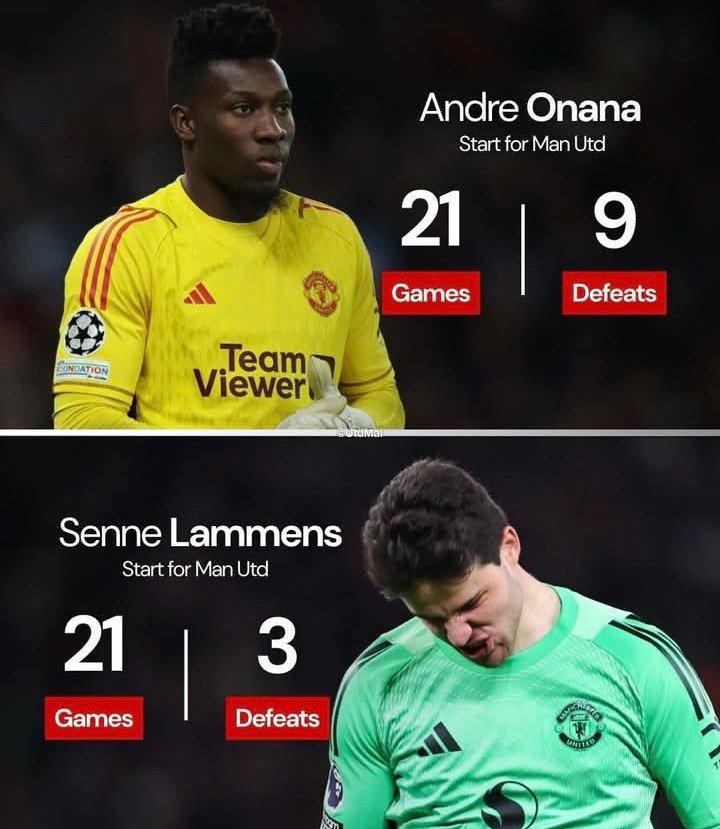
Do Manchester United look more secure with Lammens in goal than they ever did with Onana?
There is a noticeable shift in the atmosphere around Manchester United’s penalty area this season. The anxiety that once rippled through Old Trafford whenever the ball was played back toward goal has eased, replaced — at least for now — by a sense of steadiness. Much of that change has been attributed to the presence of Senne Lammens between the posts and the contrast with the turbulent spell that preceded him under André Onana.
Security in goal is not only about spectacular saves. It is about predictability, reliability, and the quiet confidence a goalkeeper transmits to the defenders in front of him. During Onana’s tenure, there were moments of excellence — sharp reflex stops, brave distribution under pressure, and the occasional match-winning performance.
However, those highs were too often offset by costly errors. Mishandled crosses, misjudged positioning, and lapses in concentration created a lingering doubt. When defenders sense hesitation behind them, their own decision-making can become rushed or overly cautious.
Lammens, by contrast, has built his early reputation on doing the fundamentals well. He catches what should be caught.
He parries wide rather than into danger. He commands his six-yard box with authority beyond his years. None of this is glamorous, but it is the bedrock of defensive stability. Full-backs appear more willing to push forward, centre-backs hold their line with greater conviction, and there is less frantic scrambling after routine set pieces.
Another factor is composure under pressure. Onana’s style was proactive and bold, sometimes to the point of risk. He was comfortable with the ball at his feet, often acting as an auxiliary playmaker.
While that trait can be valuable in a possession-based system, it also magnified the consequences of mistakes. Lammens seems more selective. He distributes efficiently without overcomplicating situations, choosing safety when necessary. That pragmatism has reduced unforced errors and, with them, the nervous energy that once defined tense moments.
Statistics only tell part of the story, but the eye test reinforces the perception of improvement. The volume of clear-cut chances conceded may not have changed dramatically, yet the number of avoidable goals appears lower.
Supporters often speak about “trust” in their goalkeeper — a feeling that the expected outcome will occur. That trust seemed fragile during stretches of Onana’s time at the club. With Lammens, it is steadily growing.
Still, perspective is essential. Lammens is young and has not yet endured the full arc of a demanding Premier League campaign. Form can fluctuate.
Opponents will analyze his tendencies and look for weaknesses. The real measure of security will come during prolonged adversity — in away matches under intense pressure, in decisive European ties, or during inevitable dips in collective form.
For now, though, the difference feels tangible. Manchester United appear calmer at the back, less prone to self-inflicted wounds, and more cohesive as a unit. Whether this marks the beginning of a long-term solution or merely a promising chapter remains to be seen.
But in the present moment, there is little doubt: the team looks more secure, and that sense of reassurance has made a meaningful impact on performances and belief alike.