**EXTENSION: Why New Orleans Saints WR Chris Olave DESERVES $35 Million A Year And Why APY Is Fake**
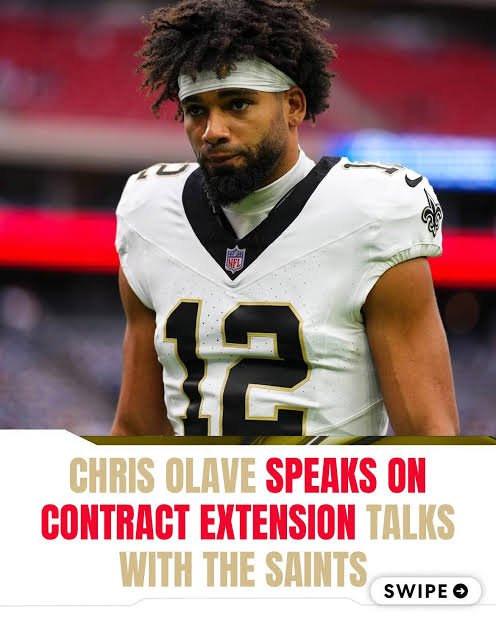
The New Orleans Saints are staring down one of the most pivotal offseason decisions in franchise history: how to keep Chris Olave in black and gold long-term. The 25-year-old wide receiver just delivered a career-best 2025 season—100 catches for 1,163 yards and nine touchdowns in 16 games—while earning his first AP All-Pro nod and cracking the PFF Top 101 at No. 97. He led the Saints in every major receiving category, posted a rock-solid 78.0 overall PFF grade (22nd among qualifying WRs), and looked every bit the alpha in Kellen Moore’s offense alongside quarterback Tyler Shough.
With Olave entering the final year of his rookie deal on a $15.5 million fifth-year option, extension talks are heating up. Spotrac’s market-value projection sits at roughly $131 million over four years ($32.75 million APY). Local reporting suggests the Saints and Olave both want a deal done before training camp. But here’s the bold truth the analytics crowd and salary-cap Twitter will hate: Olave doesn’t just deserve a monster extension—he deserves **$35 million per year**. And the reason the number feels scary is the same reason most fans get contract analysis wrong: APY is fake.
Let’s start with the production. Olave has now cleared 1,000 yards in three of four seasons when healthy. In 2022 (rookie year): 72-1,042-4. In 2023: 87-1,123-5. He played only eight games in 2024 because of concussions, but still paced for over 800 yards. Then came the bounce-back 2025 masterpiece—100 receptions on 156 targets, 11.6 yards per catch, nine scores, and a league-leading target share in the slot where he posted an 82.5 PFF grade with zero drops on 57 targets. He’s a deep threat who can win underneath, a YAC monster when the scheme opens lanes, and a red-zone nightmare (nine TDs in 2025 alone). At 6-0, 187 pounds with 4.39 speed and elite route polish out of Ohio State, he’s the complete package.
Compare him to the current WR1 market. Ja’Marr Chase just reset everything with a four-year, $161 million deal at $40.25 million APY and $112 million guaranteed. Justin Jefferson got four years, $140 million at $35 million APY with $110 million in guarantees. CeeDee Lamb: four years, $136 million at $34 million. A.J. Brown and Garrett Wilson sit in the $32-33 million range. Olave’s 2025 numbers stack up favorably—fewer yards than Chase’s monster seasons, sure, but comparable target volume, better catch rate in some metrics, and he did it with far less quarterback stability until Shough took over. He’s younger than all of them except Wilson. He’s missed only nine games in four years despite the concussion scare that limited him in 2024. Durability questions exist, but the tape and advanced metrics scream “elite No. 1.”
The Saints’ offense finally has an identity under Moore. Olave’s 39.7% share of team air yards and 27.6% target share in 2025 show he’s the focal point. Extending him now—while he’s still on a team-friendly rookie structure—locks in continuity for a young core that includes Shough, a revamped offensive line, and emerging weapons. Letting him play out 2026 on the option and testing free agency in 2027 would be malpractice. The franchise tag for WRs in 2026 projects around $28-29 million; a second tag in 2027 jumps higher. Paying market rate now avoids that nightmare.
So why $35 million specifically? Because that’s where the top tier lives once you adjust for reality. Jefferson’s $35 million set the previous benchmark for a true WR1 entering his prime. Olave is 25. He’s ascending. He’s proved he can be the alpha without a generational quarterback for most of his career. In today’s NFL, where passing games dictate everything and salary-cap space is manufactured through restructures, $35 million isn’t “overpay”—it’s the new going rate for difference-makers who command 25-30% of targets and move the chains on third down. Olave’s 53 first downs in 2025 and consistent 60+ yard long receptions show exactly that.
Now, the part everyone gets wrong: **APY is fake**.
NFL contracts are not salaries like NBA or MLB deals. They are cap-accounting instruments designed by agents and capologists to backload money, create void years, and minimize dead-cap risk. The headline “$35 million per year” almost never means the player pockets $35 million annually in cash. It’s a manufactured average that includes option years that will void, escalators that may never trigger, and incentives tied to Pro Bowl appearances or team wins.
Take a real-world example. When teams “extend” a player, the reported APY is usually new money divided by new years added—not the player’s actual average earnings over the full contract length. Add two void years at the end with inflated salaries that never get paid? Boom—APY jumps $3-4 million overnight, but the real cash flow over the first three years stays reasonable. That’s why OverTheCap and Spotrac constantly warn that total value and APY can be misleading. Jefferson’s deal looks like $35 million APY, but the real three-year cash is closer to $88-90 million guaranteed. Chase’s $40.25 million headline comes with $112 million fully guaranteed, but the back end is structured so Cincinnati can get out if needed with manageable dead money.
This is why screaming “$35 million is insane!” at Olave’s extension is misguided. A four-year, $140 million deal at $35 million APY can be built with $90-100 million fully guaranteed, escalating base salaries that the Saints can restructure later, and void years in 2030-31 that never hit the books if the relationship sours. The Saints are already masters at cap gymnastics (see: recent Carr and other restructures). They can make the annual cap hit for 2026-2029 sit comfortably in the $28-32 million range while the headline APY satisfies Olave’s camp.
Guaranteed money is the real currency. Total new cash over the first three years. Cap percentage in the signing year. Those are the metrics that matter. Olave’s camp will point to Chase and Jefferson’s guarantees north of $110 million and demand similar security. The Saints can deliver that without crippling 2027-2029 cap space because the league’s salary cap is projected to keep rising $10-15 million annually. A $35 million APY deal signed in 2026 will represent roughly 11-12% of the cap—right in line with what Jefferson and Lamb commanded when they signed.
Critics will cry “concussion history.” Fair concern. But Olave played 16 games in 2025, logged a career-high 887 snaps, and showed no lingering issues after the blood-clot scare late in the year. The medical staff cleared him. The tape shows the same explosive separator he’s always been. One bad 2024 doesn’t erase three elite seasons. Every top WR has injury questions at some point—Chase has dealt with hip and foot issues, Jefferson missed time, Lamb has had nagging stuff. Risk is baked into every big deal.
The alternative is worse. Let Olave hit unrestricted free agency after 2026 and the price skyrockets. A 26-year-old proven WR1 with Olave’s profile in a wide-open 2027 market? Expect $38-40 million APY bids from teams with cap space (looking at you, Jets, Panthers, Giants). The Saints would either overpay then or lose their best skill player for a compensatory pick that won’t replace his production.
New Orleans has the pieces. Shough is developing. The offensive line is young and ascending. Moore’s scheme maximizes Olave’s strengths. Paying him $35 million APY—structured smartly with real guarantees north of $95 million—secures the offense’s cornerstone for the next half-decade at a price that ages gracefully as the cap explodes.
APY is a headline. It’s marketing. It’s not the check the player cashes every April. The Saints’ front office knows this. Olave’s agents know this. Fans should too. Chris Olave has earned the bag. Thirty-five million per year isn’t crazy—it’s the new normal for a player of his caliber. And once you peel back the fake APY curtain, the deal becomes not just justifiable, but necessary.
The Saints have their WR1. Now they just need to pay him like one—$35 million style, structured the smart way. The extension window is open. Time to close it before someone else does.